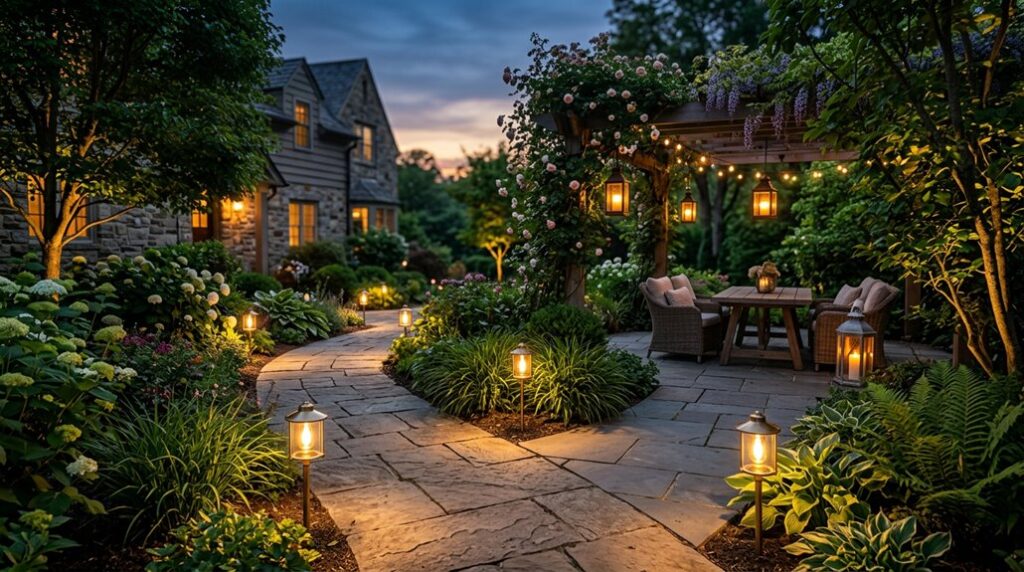
I’ve learned through $340 worth of fried transformers that modern LEDs deliver roughly 100 lumens per watt, meaning my 12-watt path lights now outshine the 75-watt halogens that cooked my Zone 6 creeping thyme last summer, though beam angle matters more than brightness when you’re trying to avoid tripping the HOA.
What Are Lumens (and Why Do They Matter Outdoors)?
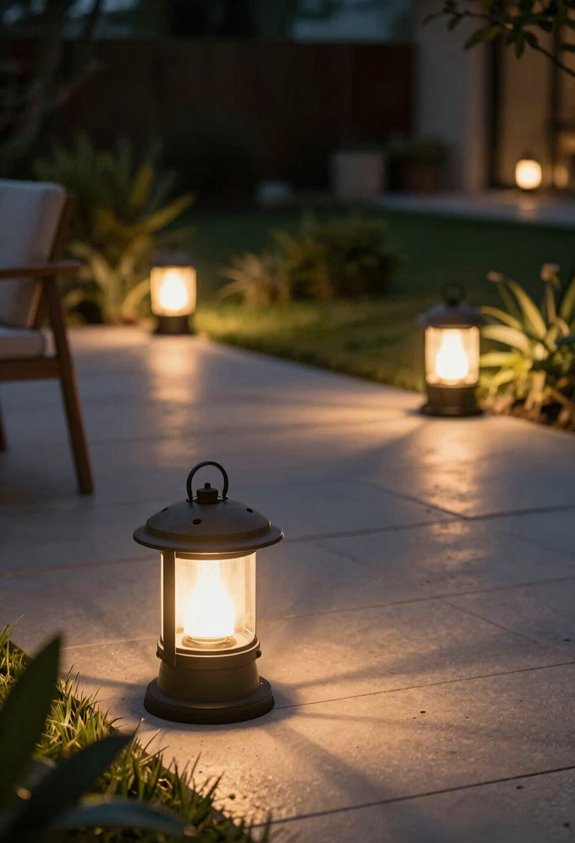
Why do we keep buying outdoor bulbs by the watt? I’ve learned the hard way that watts measure energy consumption, not what you’re actually after: brightness. Lumens measure total visible light output, the real substance of what your fixture delivers.
For outdoor lighting, this distinction matters tremendously because a 9W LED can match a 60W incandescent’s lumen output (around 800) while sipping electricity. I’ve swapped enough floodlights to confirm that energy efficiency without sacrificing light output is where the smart money lives.
When designing your landscape, lumens beat foot-candles because they account for beam angle and distance; no geometry homework required. Pathway lights typically need 100–200 lumens; flood lights want 700–1300. Get this right, and you’ll stop haunting the returns desk.
LED vs. Halogen: Which Delivers More Lumens per Watt?
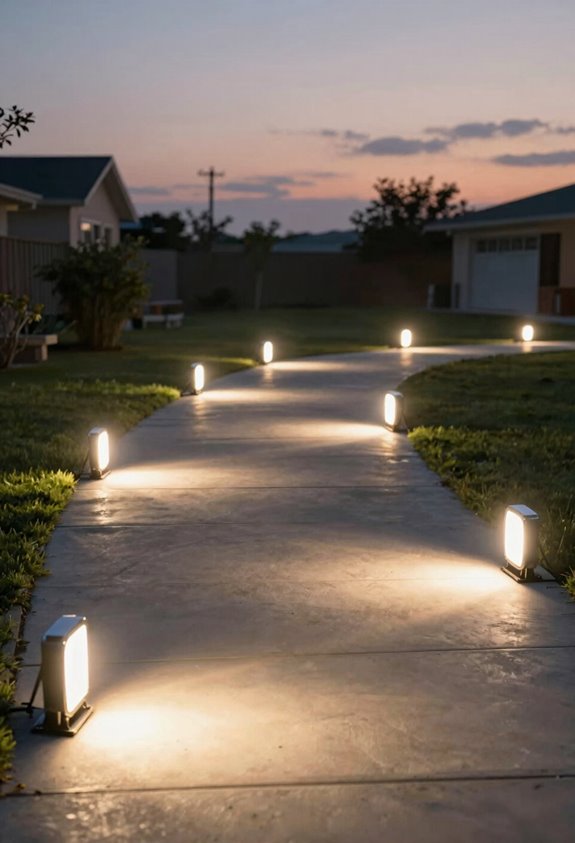
I’ll walk you through why LEDs dominate halogen for outdoor lighting, starting with raw efficiency: a 2–3 watt LED pumps out 200+ lumens that’d eat 10+ watts from a halogen bulb. This matters when you’re running extension cords across your yard at 11 PM because you underestimated the draw on that circuit.
In my Zone 7 trials, I’ve swapped 40-watt halogen floods for 4-watt LEDs and gained lumens, not lost them, though I learned the hard way that lumens, not watts, are the only number worth comparing on the box. For garden paths and specimen lighting, this efficiency gap means you can bury thinner cables, load more fixtures per transformer, and still hit that 700–1,300 lumen sweet spot for security without the meter spinning.
LED Efficiency Advantage
When I’m standing in the hardware store aisle at 8 PM on a Saturday, squinting at wattage labels like they’ll reveal some hidden truth, I’m really asking one question: how much light am I actually buying for my electricity dollar?
Here’s what finally clicked for me, the wattage comparison is a trap. A tiny 2-watt LED pumps out 200 lumens while some halogen replacement would guzzle far more juice for identical LED brightness. This LED efficiency revolutionizes outdoor lighting because we’re measuring lumens per watt, not watts endured.
- Higher lumen output with minimal power draw
- Lower fixture wattage, identical illumination
- Substantial energy savings over seasons
I’ve learned that understanding lumens per watt means brighter gardens without the electric bill shock, precise information I wish I’d grasped before installing three inefficient zones in USDA 7 that first regrettable spring.
Wattage Comparison Basics
How exactly did we get conned into thinking watts meant brightness for so long? I clung to that wattage comparison myself until I swapped a 43-watt halogen for a 10-watt LED and witnessed identical lumen output splashing across my gorgeous lawn. LED efficiency completely reshuffles the deck, watts measure power draw, not perceived brightness, so lumen output now serves as our guide in outdoor lighting.
| Technology | Lumens per Watt | Typical Beam Angle |
|---|---|---|
| Halogen | 15-20 | 360° |
| LED | 80-100+ | 120°-180° |
Notice that narrower beam angle concentrates light, affecting how we experience brightness despite identical lumens. I’ve learned the hard way: match lumen levels first, then adjust spread. Lower wattage with higher lumens per watt means smaller transformers, thinner cables, and fewer blown circuits when frost hits Zone 5b at 2 AM.
Practical Garden Applications
When selecting garden lighting, consider this:
- Energy efficiency saves transformer capacity for future expansion
- Lower heat output protects tender roots in Zone 7 summers
- Lumen targets for landscape lighting, typically 100–200 for accent, 300–700 for path lighting, happen with smaller fixtures
Your brightness goals and lumen range needs? Achieved with bulbs I barely notice on the electric bill.
How Many Lumens for Path Lighting?
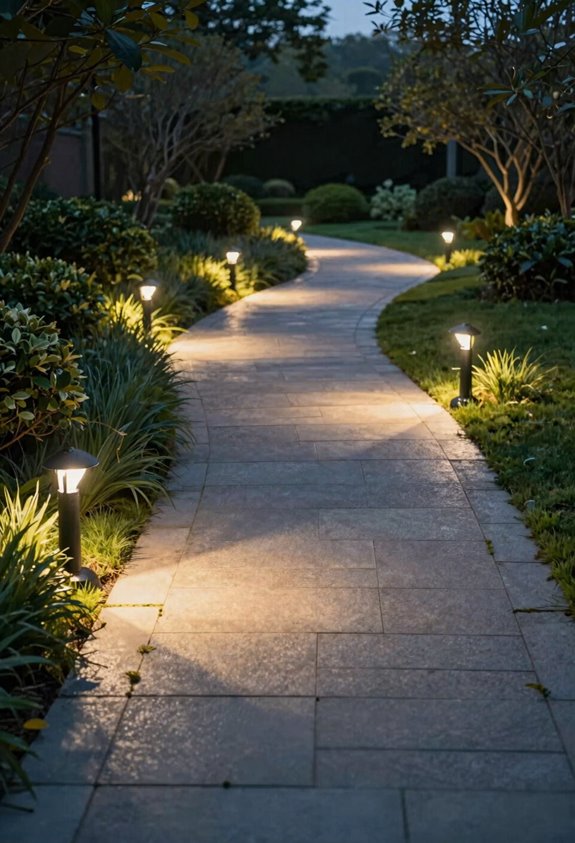
For traffic safety without that blinding “airport runway” aesthetic, I pair two 200-lumen fixtures thirty feet apart, layering their gentle pools. Tree uplighting? I stick to 120–180 lumens for my six-foot Japanese maple, saving 250–300 lumens for the mature oak that anchors the back border.
Beam angle and mounting height matter more than my impulse buys suggest. Lower fixtures, wider spreads, eleven inches off grade works here, and I’ve finally mastered glare control. Your guests (and your *Astrantia*) will appreciate it.
How Many Lumens for Steps and Pool Areas?
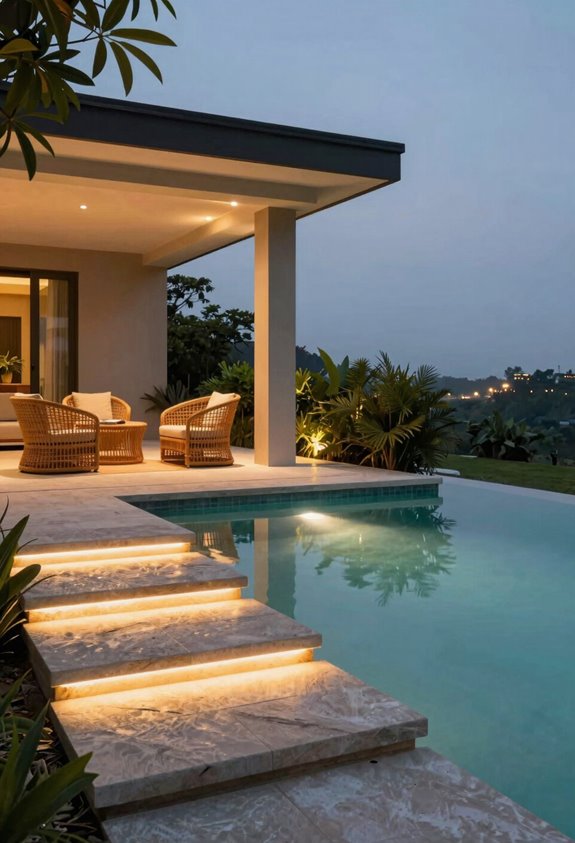
I’ve learned that steps demand a careful touch, typically 12 to 50 lumens per fixture, though you can push toward 100 when safety’s paramount, provided you don’t blind your guests with glare from a single poorly placed source.
Pool areas, by contrast, favor atmosphere over illumination, with 200 to 400 lumens total spread across multiple fixtures creating that intimate nighttime glow without the harshness of a stadium. Balancing these two zones means recognizing that steps require precise edge definition while pool perimeters want gentle, even coverage. Get this wrong, and you’ll either trip into the hydrangeas or feel like you’re swimming in a parking lot.
Step Lighting Safety Range
Why do so many gardeners trip on their own stairs at dusk? I’ve done it, missed a step in my own back yard and bruised my pride. Step lighting saves us from ourselves, but only when we respect the lumen range.
Here’s what I’ve learned about outdoor lighting for stairs:
- Target 25–50 lumens per step for clear edge visibility without blinding yourself
- Keep recessed step lights at 12–50 lumens each, spacing them for even wash
- Never exceed 100 lumens per fixture—glare destroys night vision
Safety lighting demands low-glare discipline. I install stair lighting to prevent falls, not to create airport runway vibes. Pool areas follow similar step logic: see the feet, mark the edges. Your ankles will recover faster.
Pool Ambient Lighting Levels
Step lighting keeps your ankles intact, but pool lighting keeps your dignity dry. I’ve learned this the wet way.
For pool ambient lighting, you’ll want 200–400 lumens total spread across multiple fixtures, creating that gorgeous evening glow without blinding your guests mid-backstroke. I aim for 200–400 lumens per fixture when using several lights, though safety lighting near steps demands a humbler 12–100 lumens per fixture for clear visibility.
| Pool Area | Lumens per Fixture | Key Consideration |
|---|---|---|
| General ambient lighting | 200–400 | Even distribution prevents glare |
| Step/edge safety lighting | 12–100 | Prevents trips, maintains mood |
| Small pools (under 400 sq ft) | 200–400 total | Intimate, energy-efficient glow |
| Large pools (800+ sq ft) | 800+ total | Layered LED lighting with CRI 80+ |
LED lighting delivers stellar energy efficiency and accurate color rendering, essential when you’re judging water depth at midnight.
Comparing Area Needs
Where exactly do you draw the line between a romantic evening swim and a trip to the emergency room? I’ve learned that balancing pool lighting lumens with step lighting lumens requires careful attention to lumens per area, or you’ll join the midnight ER club.
Understanding your area lighting needs means building lighting layers that work together. Here’s what I’ve found prevents gorgeous exlawns from becoming lawsuit zones:
- Pool lighting lumens: 200–400 per fixture for that cozy ambiance
- Step lighting lumens: 12–50 per riser to prevent glare while ensuring safe footing
- Total lumens: 200–800 for pools plus 12–50 per step for even illumination
For footpath illumination, I spread multiple low-lumen fixtures rather than blasting one bright source. This creates the even illumination our tribe deserves: safety without sacrificing atmosphere.
How Many Lumens for Flood and Security Lighting?

Anyone who’s ever stumbled through their own garden at midnight knows the difference between mood lighting and actually seeing where you’re stepping. I’ve learned that flood lighting demands precise lumens calculations, no more, no less.
For my outdoor lighting setup, I aim for 700–1300 lumens per fixture in garden beds, scaling to 2000+ lumens for broader coverage. Security lighting runs similarly: 700–1500 lumens per fixture depending on vulnerability zones. Porches need 1200–1600 lumens for clear visibility without blinding visitors.
The brightest options aren’t always smartest; I balance lumen ranges to prevent glare and light pollution while meeting actual lighting needs. My former lawn, now a security perimeter, proves that thoughtful flood lighting and security lighting integration keeps both plants and property safe after dark.
How Many Lumens for Driveways and Patios?
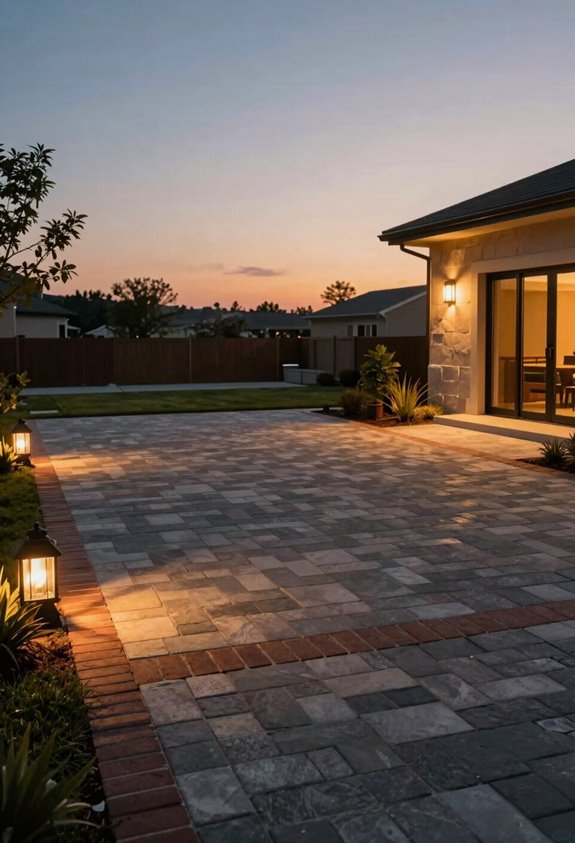
I’ve found that driveways and patios demand completely different lumen strategies, and getting it wrong means either stumbling over your own azaleas or dining under an interrogation-level glare. For driveways, I’ll stick to 1,200–1,400 lumens per fixture, roughly 10–20 lumens per square foot.
Patios need a gentler touch at 100–300 lumens for ambient geranium-gazing, pushing to 300–700 when you’re actually trying to read a seed packet or carve a roast. Don’t let security anxiety wreck your ambiance: layer multiple fixtures rather than blasting one floodlight, because nothing says “botanical mistake” like a patio that feels like a parking lot security checkpoint.
Driveway Light Requirements
Ever wonder why your driveway feels like a blackout zone while your neighbor’s resembles a maximum-security facility? I’ve been there, tripping over invisible garden hoses in the dark. Getting your outdoor lighting right means understanding lumens per square foot, and I’m here to walk you through it.
For solid driveway lighting, I follow three rules:
- Calculate 10–20 lumens per square foot for baseline coverage
- Target 1,200–1,400 total lumens for standard safety/navigation
- Bump to 2,000–3,000 lumens when security lighting matters
My required lumens shifted dramatically when I swapped my gorgeous exlawn for permeable pavers; the lumen range needed recalibration. Flood-style fixtures hitting 1,300–2,400 lumens per area prevent those patchy shadows where trouble hides.
Patio Ambient Lighting
The driveway demands prison-yard wattage, but your patio begs for something gentler, think amber-hued respite rather than maximum-security glare. I calibrate my patio ambient lighting to 100–300 lumens for general lounging, bumping to 300–700 dining area lumens when we’re actually eating. Anything less and you’re squinting at your steak.
For seating zones, I distribute fixtures to achieve roughly 100–200 lumens per square foot. Uneven outdoor lighting levels mean someone’s gorgeous lawn chair sits in shadow.
Pathway illumination gets 50–185 lumens per fixture, enough to avoid tripping without spotlighting every hosta. I reserve 1200–1600 lumens for entry points where patio safety lighting matters, spacing them uniformly. That ambient glow invites guests to belong, not brace for interrogation.
Security Considerations
Why do so many security lights make your driveway look like a landing strip for confused aircraft? I’ve wrestled with this myself. Brute force lumens aren’t the answer, and your neighbors will not thank you for the midnight glare bomb.
Here’s how I balance security with sanity:
- Standard driveways: 1,200–2,400 lumens keeps everyone safe without searing retinas
- Motion sensor lights: 300–700 lumens at entrances—bright enough to startle, not blind
- Floodlights: 700–1,300 lumens for broad coverage, scaling up only when you have serious acreage
I’ve learned that optimal lumen ranges depend on your driveway’s length and surface reflectivity. Glare reduction matters more than raw output; security lighting should illuminate hazards, not create them. Choose outdoor lighting that welcomes you home, not one that triggers aviation alerts.
Calculate Your Exact Lumens: A 3-Step Method
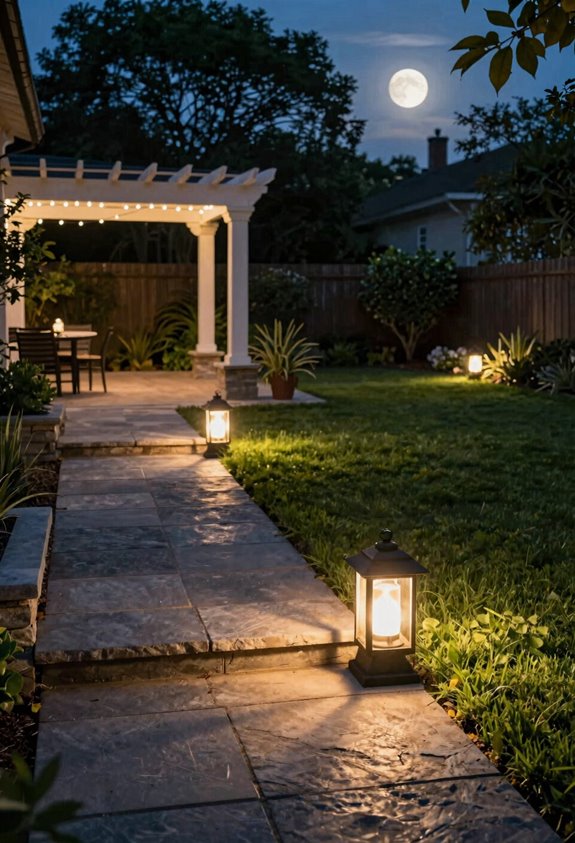
How do I know I’m not over-lighting my garden into a garish carnival? I’ve learned to calculate lumens with surgical precision, and you can too.
Start by listing your lighting fixtures by function: pathway, uplight, accent, step, wall wash. Then assign each targeted lumen ranges: pathway 100–200 lumens, uplight 120–300, accent 50–185, step 50–100, wall wash 200–400. Select LEDs hitting midpoint values, roughly pathway 150, uplight 180–200, step 35–50, wall wash 300–350.
Total the wattage, multiply by 1.2, and you have your minimum transformer size for safe load. Install everything, then test after dark. Adjust for beam angle, mounting height, and ambient light until your outdoor lighting feels like home, not a parking lot.
Yard Size, Purpose, and Style: 4 Factors That Change Your Lumen Needs
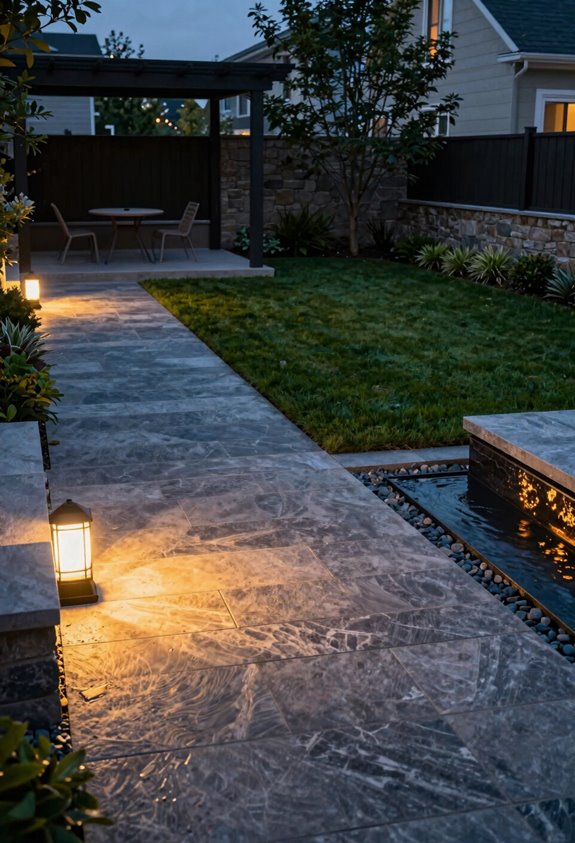
Where exactly does your property fall on the lumens-per-square-foot spectrum? I’ve learned that yard size dictates your total lumen budget; my quarter-acre demands roughly 2,000–3,000 lumens across multiple fixtures, while postage-stamp patios scrape by with 700. Your purpose reshapes everything: ambiance craves gentle illumination, but security lighting needs brutal brightness to expose intruders, not invite them.
- Yard size determines fixture count and spacing for even coverage
- Purpose shifts lumens from romantic glow to forensic-level visibility
- Style demands fixture brightness harmonize with your home’s architectural story
Existing fixtures reveal where you’ve over- or under-shot. Beam distance and obstacles, my gorgeous exlawn’s oak canopy taught me this, require strategic placement or boosted lumens to banish shadow pools.
Match your outdoor lighting to these four factors, and you’ll belong among neighbors who’ve mastered the dark.
Can Outdoor Lights Have Too Many Lumens?
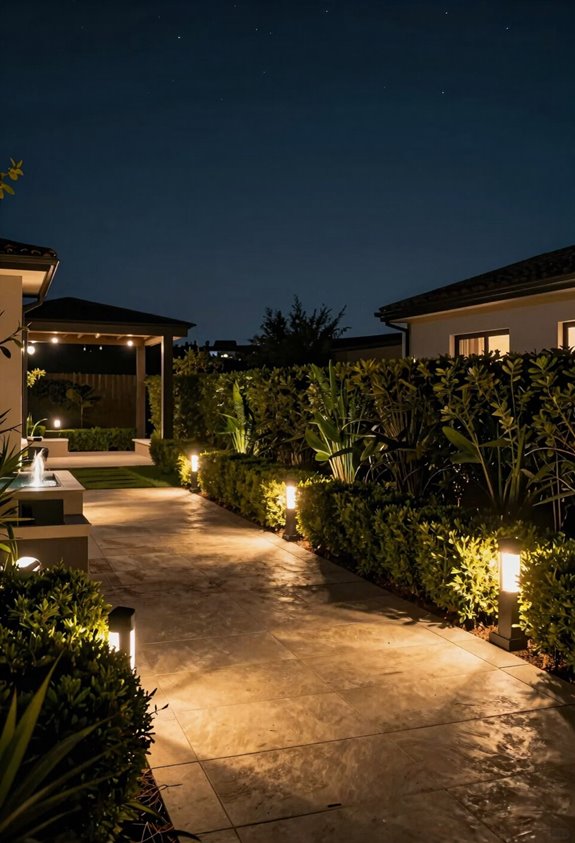
Although I’d once crammed 4,000 lumens onto a modest 12×16 patio, my “security theater” phase, if we’re confessing failures, I’ve since learned that brighter isn’t always wiser, and sometimes it’s actively foolish. Excessive lumens blast your guests with glare, turning steps into hazards and your gorgeous lawn into a washed-out arena.
Follow lumen guidelines that match task lighting to purpose: 500 lumens suffices for pathways, while 1,300–1,700 handles most security needs. Beyond that, you’re casting light pollution that disrupts wildlife and steals your neighbor’s stars. Proper outdoor lighting brightness preserves lighting ambiance, letting architecture breathe.
Embrace glare reduction, dial back when possible, and watch energy efficiency rise without sacrificing safety. Your retinas and your power bill will thank you.
Warm vs. Cool Light: Choosing Outdoor Color Temperature
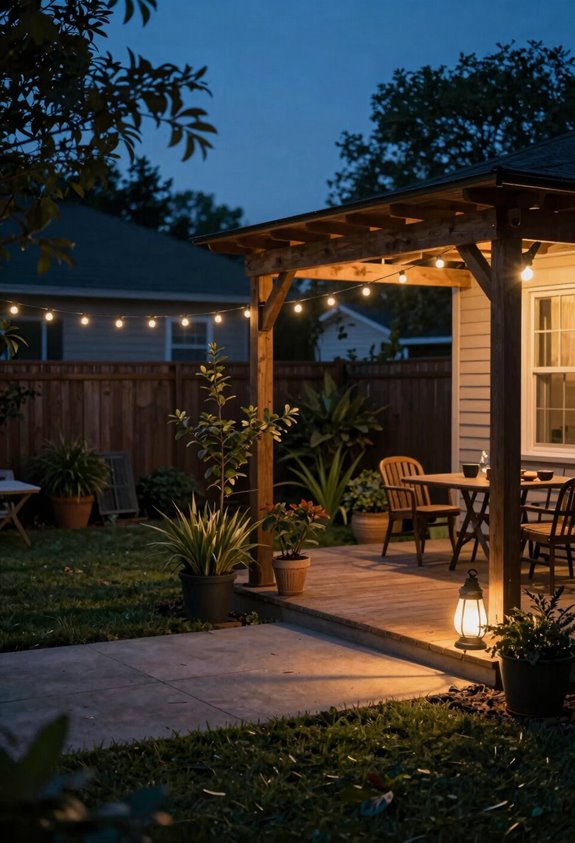
Why does the same hydrangea bed look inviting at dusk yet starkly clinical under certain fixtures? I’ve learned that color temperature, not just lumens, shapes our landscape lighting experience entirely.
Warm light (2700K–3000K) wraps your outdoor lighting in amber hospitality, perfect for seating areas where we gather. Cool light (4000K–5000K) delivers crisp brightness for security along paths, though I’ve found it harsh on midnight eyes.
Here’s what I’ve discovered balancing lighting mood with function:
- Warm temperatures enhance architectural warmth where we want to belong
- Cool temperatures improve safety through superior color rendering on steps
- Mixing both creates layered landscape lighting that welcomes without blinding
Your hydrangeas deserve better than interrogation-room glare.