I’ve rebuilt my deck three times in fifteen years, twice with cedar that rotted, once with composite that warped, and I’m finally ready to admit wood isn’t always the answer.
The 2026 market offers real alternatives: PVC that shrugs off Zone 9 humidity, thermally modified ash that lasts twenty years without chemicals, aluminum that survives wildfire embers.
Each demands different trade-offs in heat retention, cost per square foot, and whether you’ll curse yourself every summer with a pressure washer.
Here’s what actually works.
Composite Decking: The Most Popular Wood Alternative
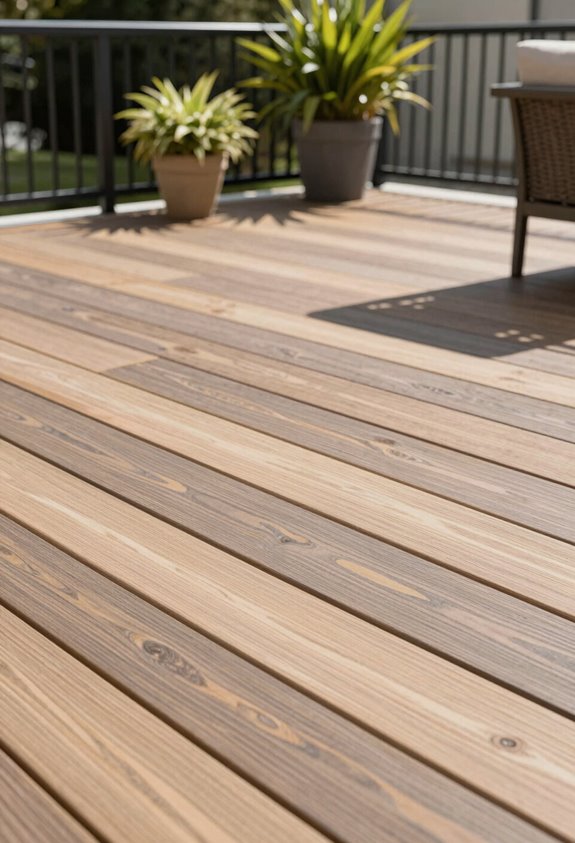
After ripping out my third cedar deck in twelve years, thanks to a particularly aggressive strain of carpenter bees that treated my backyard like an all-you-can-eat buffet, I finally gave composite decking a hard look, and I’ll confess I was skeptical about anything claiming to be “wood” yet born in a factory.
I’ve since installed composite decking on two properties, and I’m sold. The best decking material delivers genuine wood look without the splinters, rot, or annual sealing ritual. Manufacturers blend recycled materials, sawdust and polyethylene, into boards with 25- to 50-year warranty coverage for fade resistance and durability.
It’s maintenance-free beyond twice-yearly scrubbing, though heat resistance varies by brand and dark colors hit 140°F in July sun. The price point stings initially, roughly double pressure-treated, but you’ll recoup costs in five years versus staining cycles. Choose lighter hues for barefoot comfort.
PVC Decking: Waterproof Performance for Wet Climates
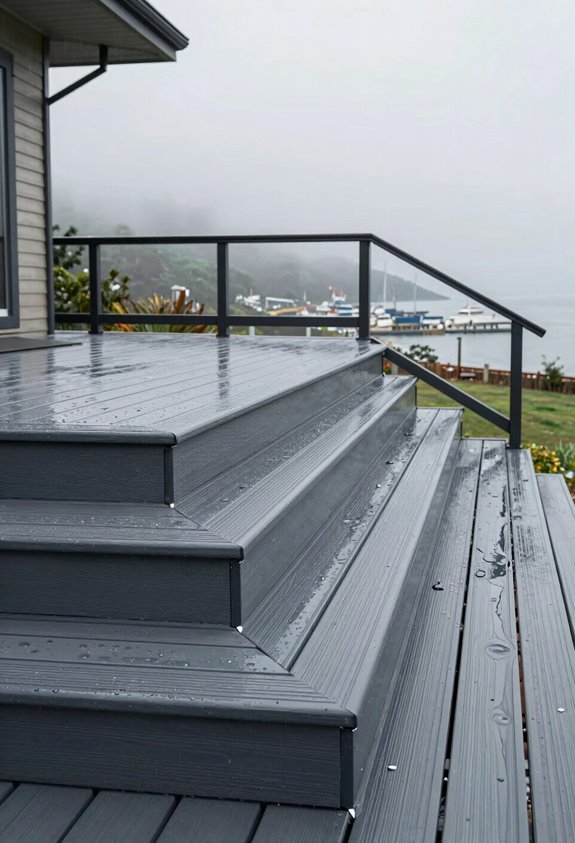
I’ve installed PVC decking in USDA Zone 8b where annual rainfall exceeds 60 inches, and its moisture resistance advantages become immediately apparent when neighboring composites start swelling at the ends after three wet seasons. While manufacturers tout cold climate suitability down to -20°F without cracking, I’ve learned the hard way that expansion gaps of 3/16 inch per 20 feet aren’t suggestions; they’re survival instructions for when January temperatures swing 40 degrees in a weekend.
The long-term cost value crystallizes around year twelve, when you’re still power-washing annually instead of replacing rotted joists, though that synthetic sheen never quite achieves the “gorgeous exlawn” warmth my spouse still mentions at dinner parties.
Moisture Resistance Advantages
Why exactly does PVC decking cost thirty to forty percent more upfront than pressure-treated pine? Because you’re buying peace of mind in a coastal climate, not just planks.
I learned this the hard way after replacing my third cedar deck in fifteen years. PVC decking delivers near-total moisture resistance: no wood fibers means zero rot, warp, or swell, even in brutal humidity. The capped decking surrounds the core on three or four sides, creating a maintenance-free barrier against moisture and delivering UV protection.
That rot resistance and weather durability translate to performance warranties stretching 25 to 50 years, not the 10-year prorated coverage I used to accept.
You’ll pay more initially, but I’ve calculated the break-even around year eight when you factor in zero sealing, staining, or painting.
Cold Climate Suitability
Where does PVC decking actually land when winter hits hard? I’ve found it holds steady, actually; its expansion contraction stays minimal when you’ve spaced those boards properly at installation. That moisture resistance doesn’t quit just because temperatures drop. Unlike my gorgeous ex-lawn, which surrendered to frost heave years ago, PVC decking shrugs off freeze-thaw cycles without warping.
The rot resistance proves equally valuable when snow piles up and meltwater lingers. No sealing means I’m not crawling around with a brush in November, and that low maintenance translates to genuine year-round ownership, even when my coastal climates friends envy my setup. Warranty lifespan claims of 50+ years sound ambitious, but I’ve watched these boards outlast three wood decks already. For cold climates, it’s practical.
Long-Term Cost Value
Three decades of deck ownership taught me that sticker shock fades faster than cedar turns gray. When you’re weighing PVC decking against composite alternatives, the math tells a soggy truth: that higher upfront cost buys you serious long-term value. I’ve watched neighbors re-stain their pressure-treated sagas every two years while my PVC planks yawn through monsoons.
Here’s what actually matters for us wet-climate survivors:
- Warranties stretching 50+ years mean you’ll likely sell the house before this deck quits
- Zero sealing, staining, or painting; just occasional soap-and-water maintenance breaks
- Rot resistance from pure synthetic construction; no wood fibers means no fungal buffets
- Moisture resistance that laughs at USDA Zone 8a downpours I’ve endured
- Up to 60% recycled materials in many brands, so your footprint stays lighter than your wallet
That durability factor? It turns weekend warriors into porch-sitters.
Thermally Modified Wood: Real Timber Without Rot or Chemicals
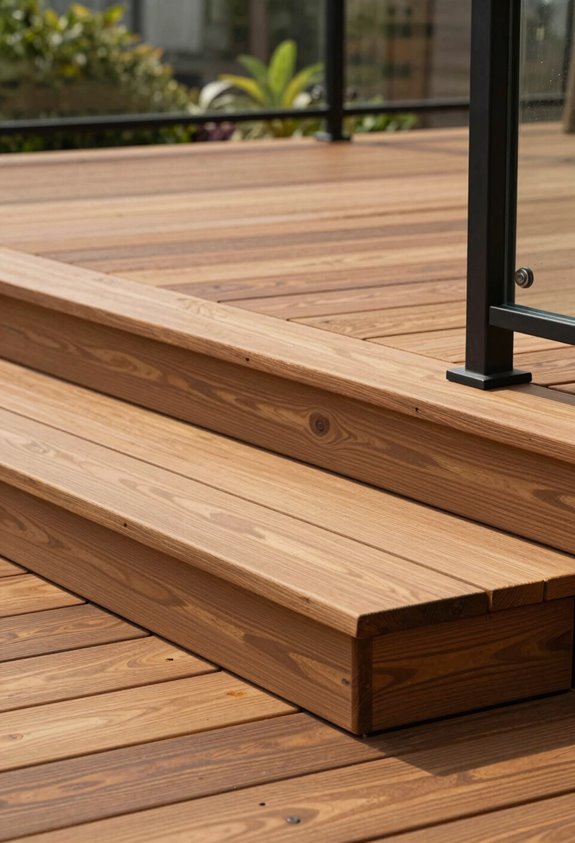
How exactly do you keep real timber from rotting without drowning it in copper azole or letting it silver into splinters within five years? I’ve found my answer in thermally modified wood, real timber baked to roughly 400°F until its cellular structure transforms. This chemical-free process gifts you rot resistance and remarkable dimensional stability; my 2×6 ash boards barely budged through three humid Virginia summers.
You’ll still get that natural wood aesthetic, but with durability that performs well in decay resistance tests. Maintenance drops significantly: no annual sealing rituals, though that chocolate-brown tone will drift toward silvery-gray unless you intervene. Weather performance impresses: reduced moisture uptake means fewer warped boards and zero fungal feasts. It’s the balance I’d been hunting, genuine grain without the guilt or the rot.
Aluminum Decking: Fireproof and Storm-Resistant for Extreme Zones
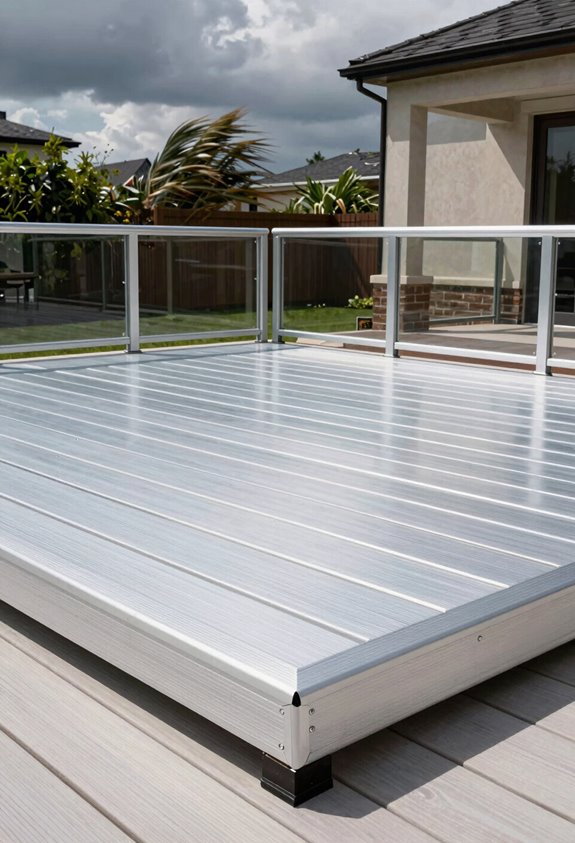
I’ve installed aluminum decking in USDA Zone 10 coastal environments where salt spray and hurricane-force winds chew through lesser materials, and its non-combustible Class A fire rating paired with zero moisture absorption makes it the only sensible choice when insurance adjusters start asking questions. The interlocking panels shed 140-mph wind uplift when fastened with manufacturer-specific concealed clips; skip the generic hardware store screws unless you enjoy watching your deck become airborne during storm season.
You’ll pay roughly $12–$15 per square foot for materials versus pressure-treated pine’s $3–$5, and the surface can sound like a rattlesnake convention during rain unless you specify the sound-dampening underlayment I learned about the hard way in my “gorgeous exlawn” phase.
Fire Resistance Ratings
Out here in Zone 9b where wildfire season stretches from June through October, I’ve learned that fire resistance isn’t just a selling point; it’s survival gear for your backyard. I chose aluminum decking for my place after a neighbor’s cedar deck went up like a roman candle in ’22; its non-combustible properties let me sleep through red-flag warnings.
- Class A fire ratings mean embers land and fizzle, not ignite
- Zero moisture resistance concerns means no rot resistance failures to invite termite parties
- Maintenance-free existence beats my annual sealing ritual on the old redwood
- Heat absorption runs higher than wood, so I hose it down before bare-foot July cocktails
- Limited color options stung my designer ego, and the upfront cost made me wince, but I’m trading that for storm resistance come hurricane season
Storm Durability Features
When hurricanes churn through the Gulf or microbursts flatten my tomato cages, aluminum decking keeps standing while my neighbors replace splintered cedar planks. I’ve watched oak branches crater my composite neighbor’s deck while my aluminum shrugged off the same 2 AM assault.
| Storm Threat | Aluminum Performance | Competitor Reality |
|---|---|---|
| Wind uplift (150+ mph) | Secures firmly, no tear-off | Vinyl panels launch like frisbees |
| Flying debris impact | Dents; doesn’t shatter or split | Cedar: 2-inch penetration; composite: cracks |
| Post-storm flooding | Complete moisture resistance, rot resistance, insect resistance | Wood swells; composite molds in 72 hours |
| Salt spray/coastal wear | Weather resistance holds through USDA Zone 10a | Steel corrodes; wood checks within 18 months |
The fire-hazard durability extends beyond wildfire zones into lightning-prone areas where my hickory canopy attracts strikes. Long-term maintenance means zero sealing; I’ve clocked six years without touch-ups.
Thermal conductivity demands strategic planning: my south-facing section hits 140°F by 2 PM, so I leveraged installation color options, choosing bone-white over charcoal, and specified textured surfaces for barefoot safety. Shaded portions stay park-bench cool, perfect for my morning coffee among the tomatoes.
Installation Considerations
How does one wrestle 20-foot aluminum planks into submission without warping the budget or the boards? I’ve learned aluminum decking demands respect, and specialized fastening systems that’ll test your patience and your wallet.
Budget 40-60% more for installation cost than pressure-treated wood; my nightmare in Zone 9b ran $18/sq ft.
Thermal conductivity isn’t theoretical; midday July surfaces hit 140°F without light color options.
Dent resistance disappoints; drop that wrought-iron planter and you’ll own the memory permanently.
Fire resistance and moisture resistance redeem everything; zero maintenance after install.
Durability in rain and weather exposure justifies the industrial aesthetic we learn to love.
Bamboo Decking: Ipe Hardness at Half the Environmental Cost
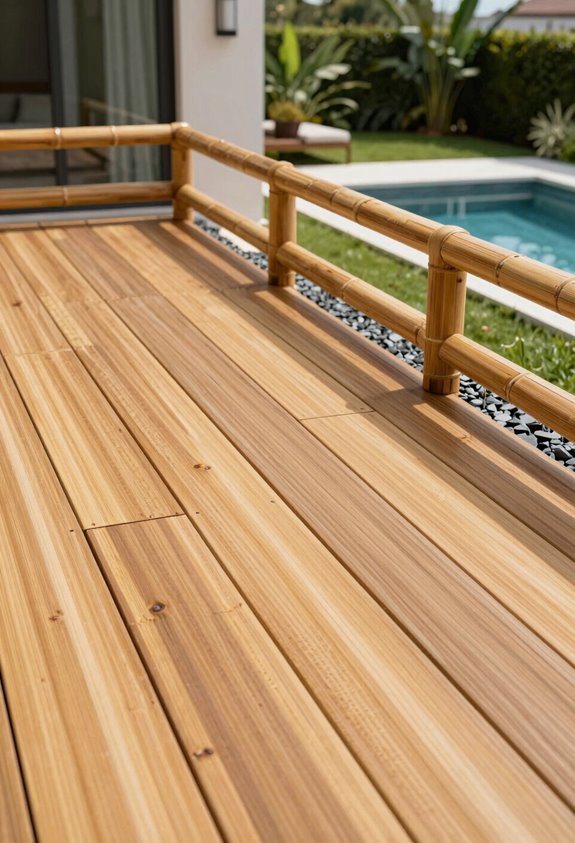
Why spend triple digits per square foot on ipe when you can get comparable hardness from something that grows back in five years? I’ve installed strand-woven bamboo decking on three hospitality patios now, and I’m convinced it’s the smartest pivot in tropical hardwood alternatives. The environmental cost drops dramatically. This fast-growing grass sequesters carbon while maturing in 3–5 years versus ipe’s century-long growth cycle. You’re looking at 20–25% savings upfront, roughly $8–$12 per square foot installed, with genuine ipe hardness (3,800+ Janka rating) and comparable durability.
Maintenance is straightforward: annual oiling, not the obsessive sanding teak demands. Weather resistance holds through USDA zones 7–10, though I learned the hard way that standing water stains without drainage. Sustainability credentials? Impeccable. Performance? Remarkably attractive material that handles commercial foot traffic without apology.
Concrete Pavers: The Lifetime-Cost Winner for Ground-Level Spaces
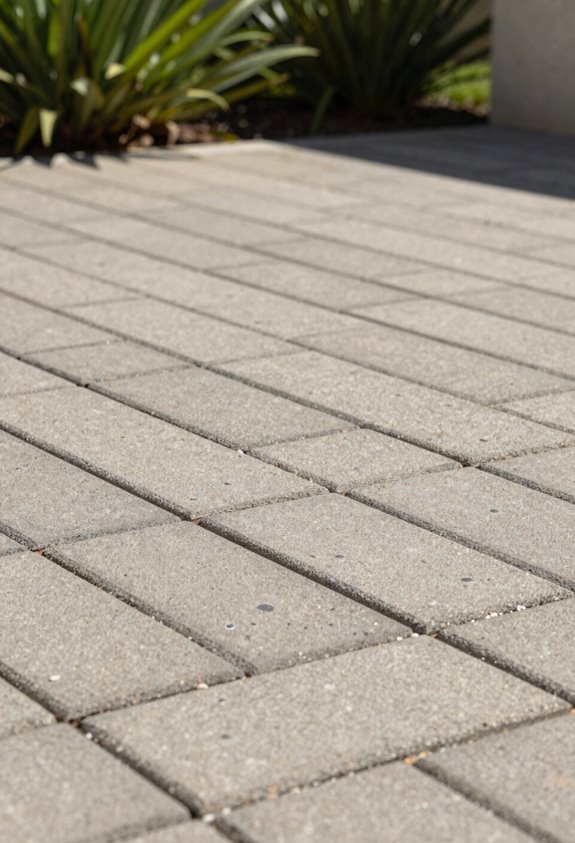
Bamboo might forgive my drainage sins, but concrete pavers never asked for forgiveness in the first place. I’ve learned that for ground-level spaces, nothing beats the lifetime-cost calculus of concrete pavers: 30–50 years of rot-proof durability with zero insect anxiety.
Installation demands level ground and stable base, and my gorgeous exlawn taught me that lesson with frost heave. But the long-term savings justify every hour of prep.
- Fireproof and pest-proof, unlike my wooden deck’s termite buffet
- Basic slabs run $3–$5/sq ft; flagstone hits $15–$30+ for show-offs
- Porcelain pavers split the difference with tile-like aesthetics
- Negligible maintenance beats annual staining rituals
- Paver options span finishes from brutalist to Mediterranean villa
Uneven terrain spikes installation cost, so I measure twice and excavate once.
How to Choose Your Decking Alternative: Climate, Budget, and Maintenance?
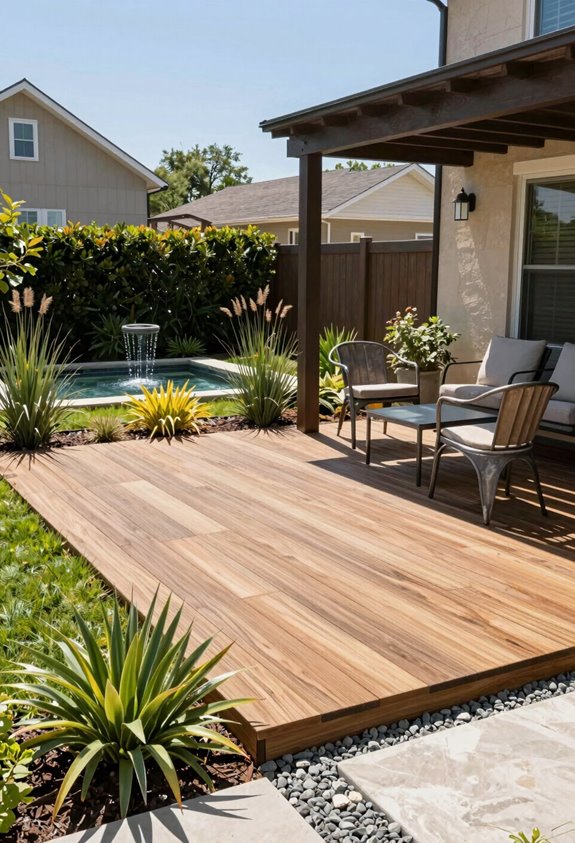
Where exactly does your deck live, and how much of your life are you willing to surrender to keeping it pretty? I’ve learned climate considerations reshape everything. In my Pacific Northwest garden, composite decking and PVC decking saved my weekends; their moisture resistance laughs at 60 inches of annual rainfall, and those 25–50 year fade warranties aren’t marketing fluff.
Your budget tells the truth upfront. Pressure-treated pine seduces at $15/square foot, but I’ve calculated the real cost: sealing every two years, replacing warped boards, watching that gorgeous exlawn turn gray. Premium composites run $35–$55 initially, yet their longevity—25–30 years with near-zero maintenance requirements—wins the ledger.
If you crave the look of natural wood, Ipe delivers 40–75 year lifespans, but demands annual oiling. For low-maintenance options, capped PVC offers the same aesthetic without the servitude. Choose your master: time or money.