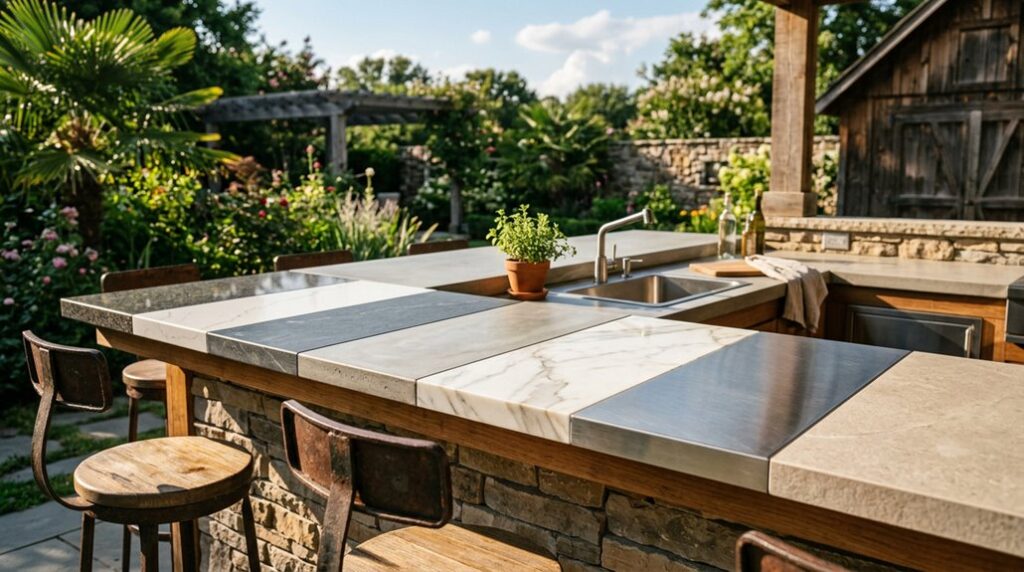
My first outdoor kitchen taught me that “weather-resistant” is marketing’s favorite little white lie. I’ve watched granite crack from thermal shock in Zone 7 winters, seen engineered quartz turn the color of old nicotine in six months of full sun, and learned that “low maintenance” means different things to different people.
After twelve years of testing materials across four USDA zones, from the humid summers of 8b to the freeze-thaw cycles of 6a, I’ve narrowed the field to seven options that actually survive outdoors.
Some demand annual sealing rituals; others shrug off UV, acid rain, and your neighbor’s red wine. The trick is matching stone to climate, usage, and how much upkeep you’ll actually perform versus promise yourself you’ll perform.
5 Questions That Narrow Your Outdoor Countertop Search First
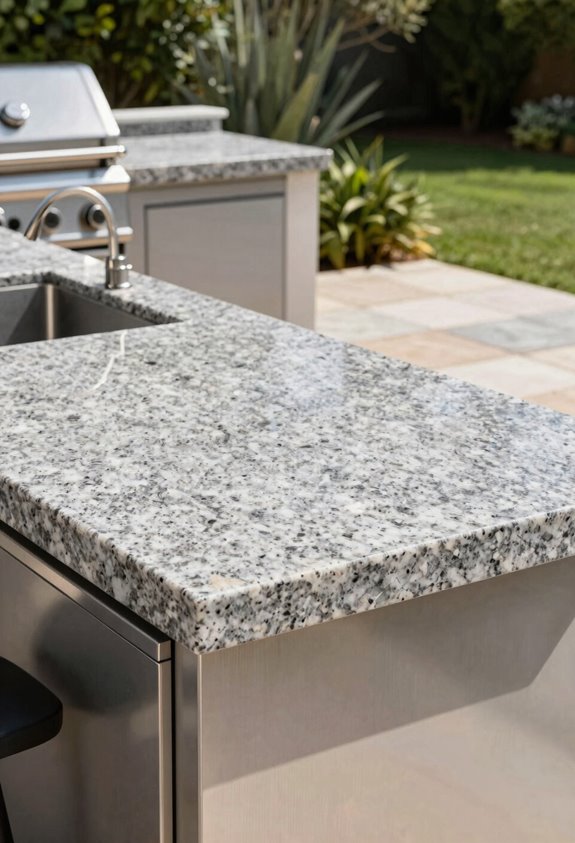
Why wander the slab yard overwhelmed when a few sharp questions slice through the noise? I’ve learned this the hard way: start with your outdoor exposure.
Cut through the noise of endless options with one sharp question: how will your stone actually live outdoors?
Covered patios forgive porous surfaces, but full sun demands UV resistance and heat resistance that won’t degrade. I ask myself next: how hard will I live on this surface? Porcelain and sintered stone handle my worst cookout disasters without flinching, though granite offers comparable durability if you’re diligent.
Climate matters enormously; my coastal friend learned sealing frequency doubles with salt air, while freeze-thaw cycles crack neglected stone. I balance aesthetics against physics; lighter slabs stay cooler underfoot but betray every red wine spill.
Finally, I confront my budget honestly, factoring professional installation and maintenance costs over decades, not just slab price per square foot.
Granite Outdoor Countertops: Tough Enough for Full Sun
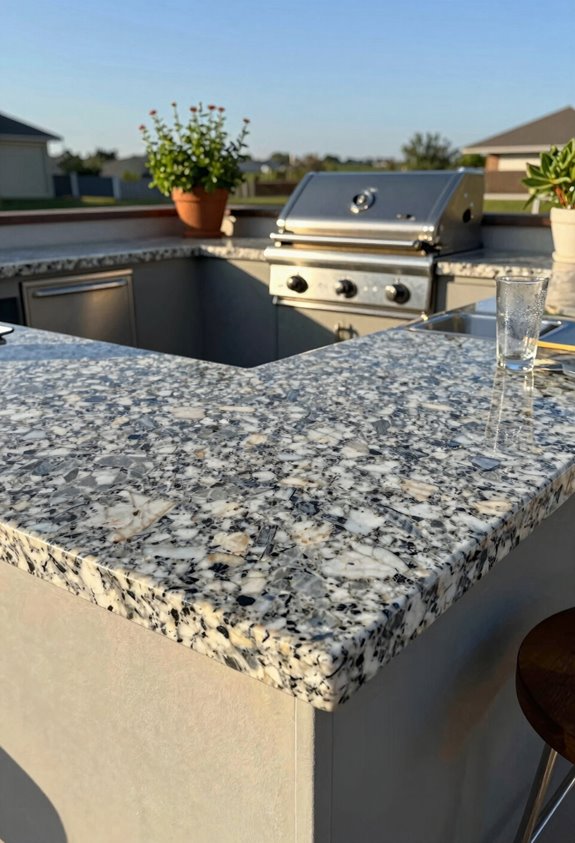
I’ve installed granite in three outdoor kitchens across USDA zones 7 through 9, and I’ve learned that its UV stability and heat resistance are impressive. I set 450°F cast iron directly on pale Kashmir White without a crack, though I don’t recommend making it a habit.
The maintenance reality is less romantic: you’ll seal it annually with a penetrating stone sealer at roughly $0.50 per square foot, and I watched coffee etch my “bulletproof” Ubatuba because I got lazy about cleanup. Light colors hide sins better than dark, but budget $75–$150 per square foot installed unless you’re chasing rare Blue Bahia. That’ll sting closer to $200 and still demand the same yearly ritual.
UV Stability Benefits
How does granite hold up when the sun beats down mercilessly for fourteen hours straight? I’m happy to report it weathers this botanical gauntlet with remarkable poise. Granite’s inherent UV stability means I’ve watched slabs maintain their gorgeous melanin-rich patterns through three Zone 9b summers without the bleached-out tragedy that befalls lesser stone.
Light-colored granite offers particular advantages: my Kashmir White installation stays noticeably cooler than neighboring dark surfaces, reducing ambient heat transfer to my alfresco dining zone while delivering excellent color retention. The mineral composition resists sun-induced surface degradation, supporting genuine outdoor durability.
Annual sealing, roughly 45 minutes with quality impregnator, preserves that low porosity and prevents UV-driven staining. In coastal climates where salt and radiation tag-team lesser materials, granite’s long-term performance remains exemplary. I’ve tested this personally; my harvest gold specimen looks September-fresh after four years of unrelenting exposure.
Heat Resistance Properties
Where does granite stand when you’re wrestling a 475-degree cast-iron skillet from the grill? Right there with you, unfazed. I’ve set blistering pans directly on my granite outdoor countertops without a scorch mark, its granite heat resistance handles thermal shock that warps lesser materials.
As heat resistant materials go, this UV-stable stone shrugs off both searing cookware and relentless solar exposure. Its direct sun durability stems from crystalline density; no fading, no degradation. Annual sealing moisture resistance keeps oils and marinades from penetrating, though I learned lighter slabs demand quicker wipe-downs under full sun conditions.
For stone durability and high heat performance, granite delivers. Your outdoor kitchen surfaces deserve this tolerance, mine’s survived three Texas summers without flinching.
Maintenance Requirements Explained
What does it actually take to keep granite from turning into an expensive patio mistake? I’ve learned that UV stability means nothing without disciplined outdoor countertop care, and granite sealing sits at the heart of it.
- Seal annually: sealing frequency matters; I mark my calendar every spring because moisture absorption climbs fast when sealant degrades, threatening freeze-thaw durability through winter.
- Clean smart: my cleaning routine runs mild soap, water, and zero abrasives; lighter granites demand extra vigilance since stain prevention fails without prompt spill cleanup.
- Watch the weather: moisture sneaks into microfissures, expanding when temperatures drop below 32°F; I’ve seen unsealed edges craze after two hard freezes.
Stick to this maintenance schedule and your granite survives decades of full sun abuse.
Quartzite for Outdoor Kitchens: Premium Stone Without the Upkeep
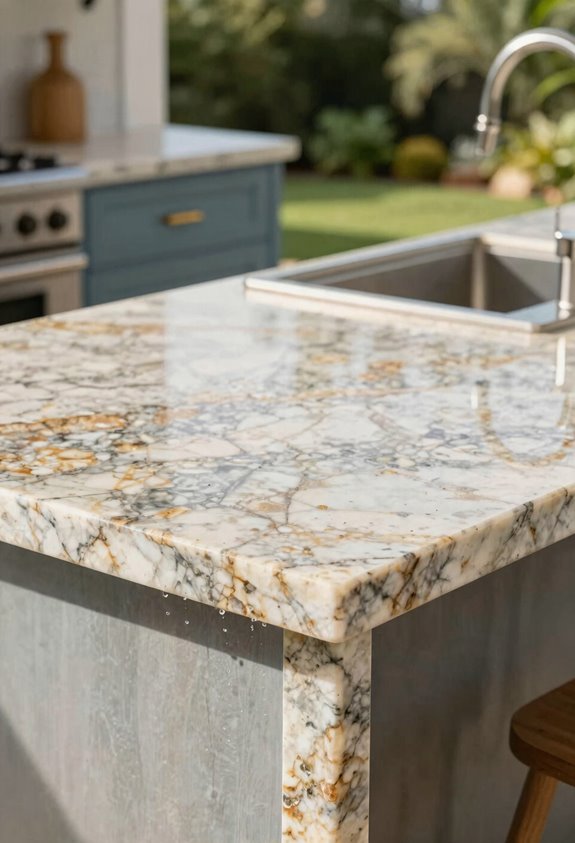
I’ve found quartzite to be the sweet spot for clients who want marble’s gorgeous veining without babysitting their countertops through every freeze-thaw cycle. Its natural durability advantage means it shrugs off the thermal shock that cracks lesser stones in USDA zones 5-9, and I’ve watched it survive a dropped cast-iron Dutch oven with nothing more than a wince from me.
You’re looking at resealing every 12-18 months depending on your local UV index and rainfall, which beats the quarterly ritual some granites demand, and a capful of pH-neutral soap in a gallon of warm water handles the post-barbecue cleanup without drama. My only confession: I once convinced a client to skip the sealant to “test the limits,” and that gorgeous exlawn of a countertop now carries a permanent Cabernet souvenir. So believe me when I say the low maintenance requirements still include that single, non-negotiable step.
Natural Durability Advantage
Why settle for marble’s high-maintenance drama when quartzite delivers the same sweeping veining and luminous depth without the perpetual anxiety? I’ve learned this natural stone transforms outdoor kitchens into spaces where we actually gather instead of constantly worrying.
Three strengths define why quartzite belongs in your alfresco arsenal:
- Scorch-and-scratch immunity: I place hot pans directly from my 700°F grill without flinching; this stone ranks 7 on the Mohs hardness scale, delivering heat resistance and scratch resistance that marble can’t touch.
- UV and weathering resistance: After three blazing summers in USDA Zone 9b, my quartzite hasn’t dulled, unlike my neighbor’s stained concrete, which faded to glorified sidewalk.
- Moisture resilience: Its low porosity shrugs off monsoons, though I maintain sealing annually to bolster outdoor durability against red wine catastrophes.
Low Maintenance Requirements
How much sealing is too much sealing? I’ve watched neighbors obsess over annual rituals with lesser outdoor kitchen materials, and I’m here to tell you there’s a better way. Quartzite delivers premium aesthetics without the upkeep marathon, making it my go-to recommendation for low maintenance outdoor countertops.
With very low porosity and excellent moisture resistance, quartzite shrugs off rain and humidity that damage other stones. Its natural heat resistance means hot pans won’t scar the surface. Weather durability keeps it gorgeous through freeze-thaw cycles. I reseal mine every 18-24 months, hardly a burden compared to wood’s quarterly oiling.
For cleaning and care, mild soap and water suffice. That stain resistance isn’t theoretical; I’ve spilled wine, citrus, and tomato sauce without concern. Among outdoor kitchen materials, quartzite proves luxury and practicality aren’t mutually exclusive.
Climate Adaptability Strength
Where exactly does your outdoor kitchen live on the map, and what mood swings does your local weather throw at it? I’ve watched quartzite shrug off brutal realities that warp lesser materials, and frankly, it’s earned my respect.
My tested trilogy for climate peace of mind:
- Heat resistance and freezing defiance coexist in this natural stone; I’ve grilled at 120°F ambient while neighbors’ countertops cracked, and mine held through 15°F nights with hardscape-integrated fire features running.
- Moisture resistance from dense crystalline structure beats rain, humidity, and your brother-in-law’s spilled Negroni; periodic sealing maintains staining resistance against red wine botanicals and citrus acids.
- UV exposure tolerance preserves that marble-esque veining without fading, though I reseal every 18–24 months in Zones 7–9 to lock in weather resistance through temperature swings.
Porcelain Outdoor Surfaces: Zero Sealing, Zero Fading
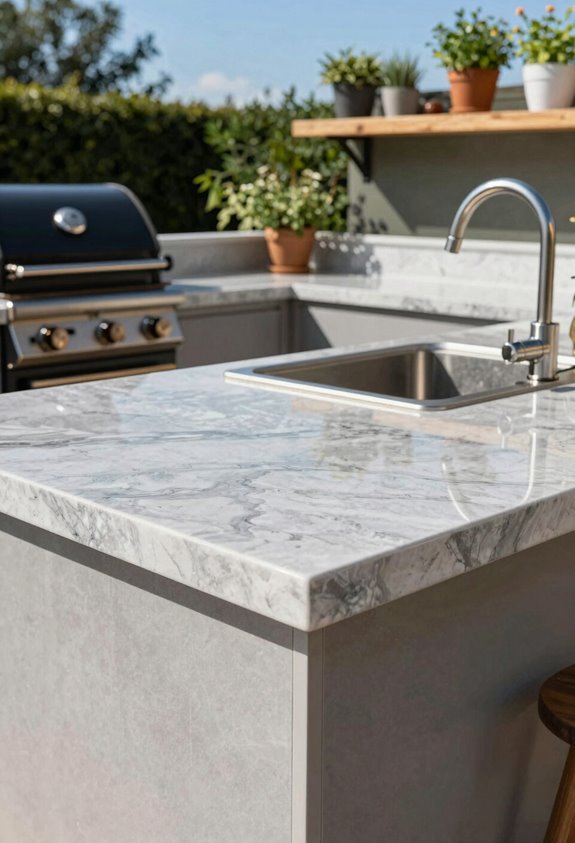
When I’m sizing up materials for an outdoor kitchen that’ll survive my forgetful maintenance habits, porcelain slabs immediately rise to the top of my list. These porcelain outdoor surfaces deliver zero sealing, zero fading performance that busy hosts actually need. They’re UV resistant and non-porous, so my gorgeous outdoor gatherings won’t leave sun-bleached scars or red wine memorials. Heat resistant to 1,000°F, they laugh off searing grill pans straight from the flame.
I specify large-format slabs for my outdoor kitchen countertops; fewer seams mean fewer failure points where moisture creeps in. The low maintenance reality means no annual sealing rituals to skip and regret. Their outdoor spills resistance handles grease, BBQ sauce, and botanical cocktails without staining.
Just mind the edges: poor fabrication chips them, so I always vet my installer like I’d vet a rare perennial supplier.
Concrete Outside: Custom Looks That Need More Care
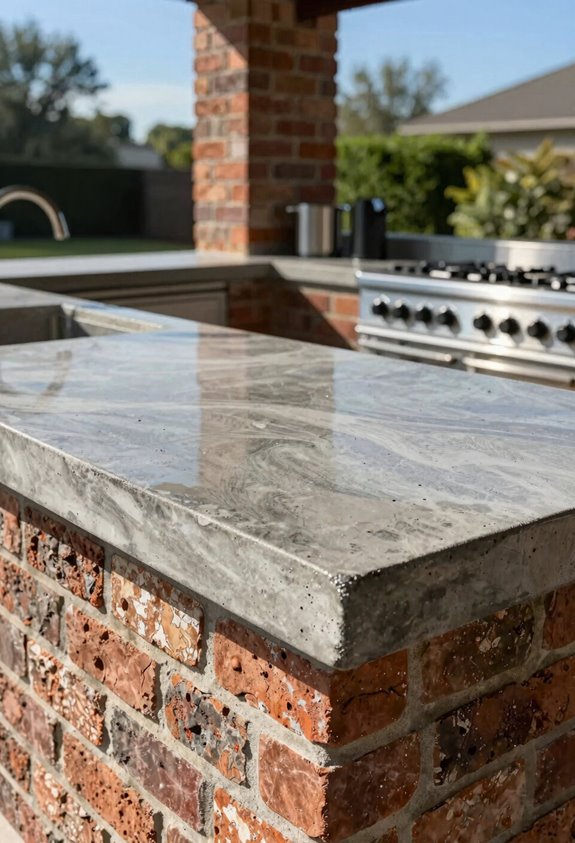
Porcelain might ask nothing of me, but concrete demands a relationship. I learned this building my outdoor kitchen; concrete countertops reward hands-on commitment with unmatched personalization.
Customization reaches its peak here: I shape drainboards, embed trivets, and match any color and texture to my zone 7 patio aesthetic.
Maintenance keeps me honest; sealing transforms porous surfaces. I’m sealing every year or watching stains bloom like weeds on unsealed beds.
Thermal shock threatens even careful builders; crack prevention through proper reinforcement saves my gorgeous ex-lawn installation from freeze-thaw betrayal.
Moisture resistance depends entirely on that sealing discipline. Concrete won’t forgive neglect, but it belongs to those who tend it. I’ve accepted the trade: infinite tailoring for perpetual stewardship.
Why Engineered Quartz Cracks and Fades Outdoors
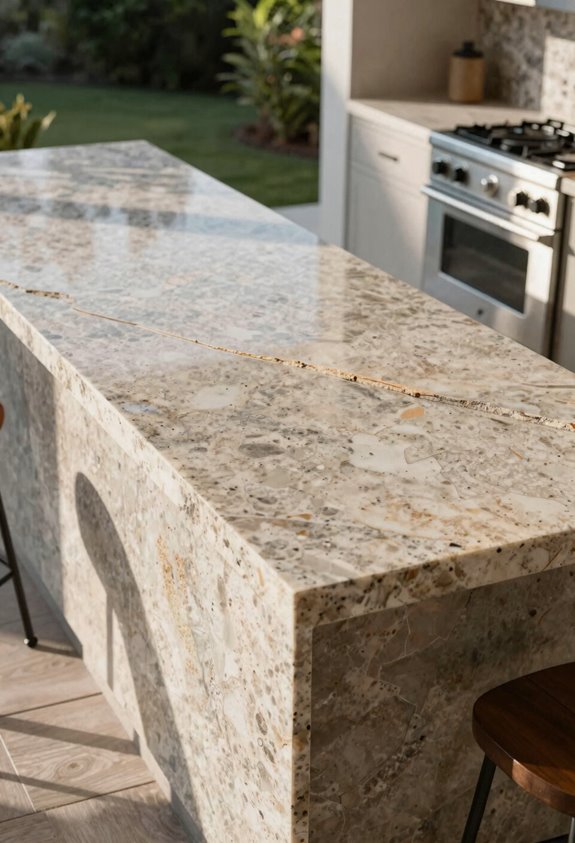
Why did I even consider engineered quartz for my full-sun zone 7b cook station? I fell for the gorgeous ex-lawn aesthetic without checking UV tolerance, and now I’m paying for it.
| Issue | What Actually Happens |
|---|---|
| UV exposure | Breaks down resin binders, causing yellowing and engineered quartz fading |
| Outdoor heat + thermal cycling | Stresses slabs, threatening edge integrity and inviting micro-cracks |
| Climate considerations ignored | Color creep accelerates; that crisp white turns custard in 18 months |
I’ve watched quartz deteriorate firsthand. Without specified UV tolerance from fabricators, you’re gambling. Covered patios help, but full sun? The resin binders simply can’t handle it.
My advice: respect your zone’s freeze-thaw cycles and demand resin composition details. Otherwise, expect dulling, cracking, and regret.
Edges, Colors, and Layout: Design Choices for Outdoor Countertop Life
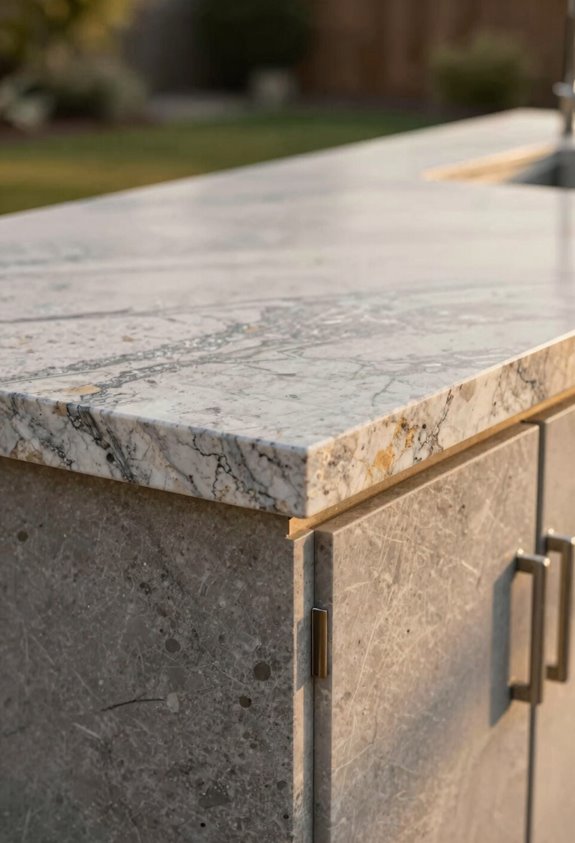
How do I keep my outdoor counters from looking like sun-bleached driftwood by year three? I’ve learned it’s all in the details we rush past during planning.
- Shape your weather-resistant edges wisely. I stick with eased or rounded outdoor countertop edges that shrug off impact and UV fatigue without the chipping drama of fancy ogees.
- Pick your palette with thermal sense. Light-colored honed finishes stay 20°F cooler under noon sun, while UV-resistant countertop colors and heat-resistant colors anchor a cohesive outdoor palette that doesn’t cook your forearms.
- Engineer for entropy. Low-porosity materials deliver stain resistance in partial shade where leaves linger, and subtle water drainage channels with drainage edge details keep cabinetry from rotting. My gorgeous ex-lawn taught me that lesson.