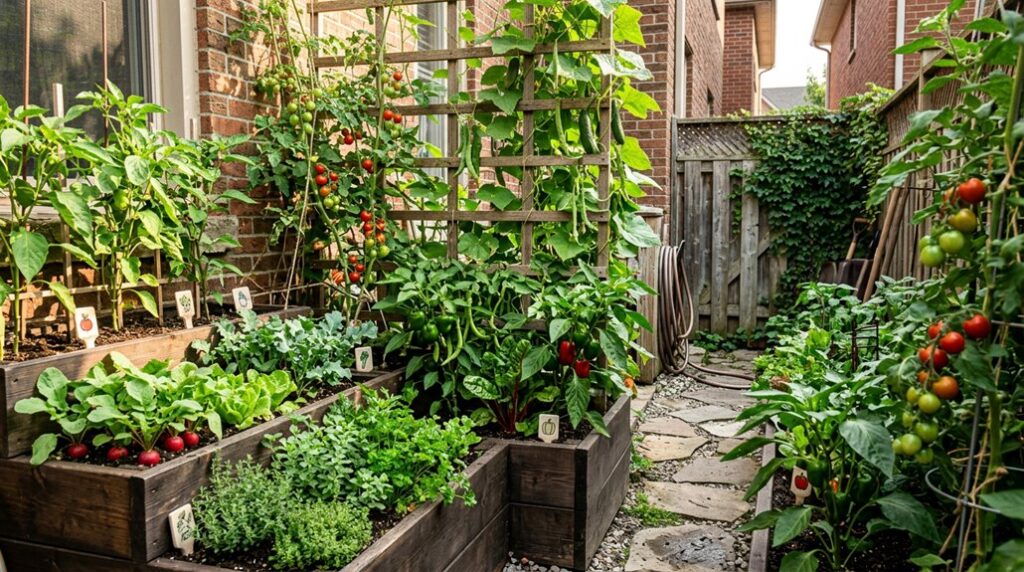
I’ve learned that small backyards don’t ask for sympathy, they demand strategy. After three seasons of wedging tomatoes into a 10-by-12-foot patch in Zone 7b, I discovered that vertical real estate outperforms horizontal every time.
My first trellis collapsed under a ‘Brandywine’ harvest, but the second, staked with 8-foot electrical conduit at $14 per bed, now supports 18 pounds of fruit without wobbling. You’ll need to account for your own sun traps and drainage disasters before committing to soil.
Assess Your Sun Before Planning Layouts
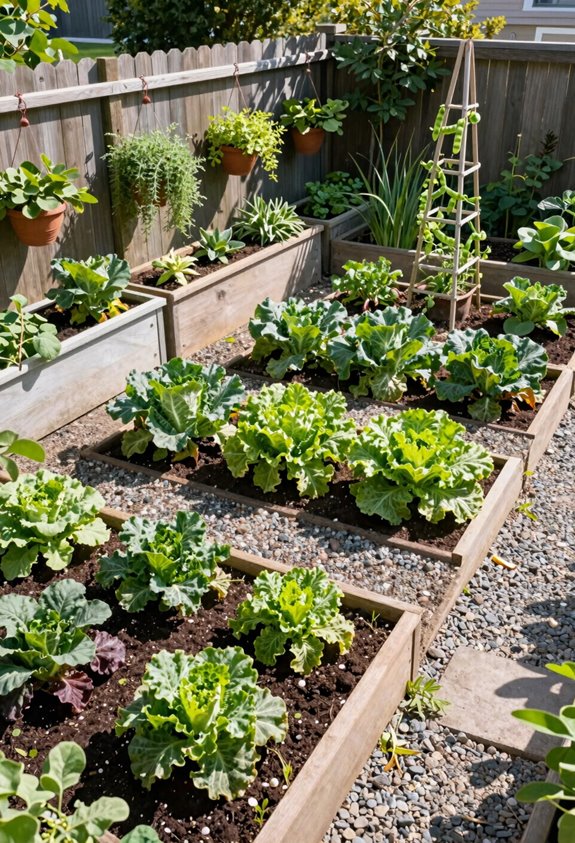
Where does your backyard actually get sun, and for how long?
Track your yard’s actual sun exposure—hours and timing—before you plant.
I learned this the hard way after planting tomatoes in what I thought was my sunniest corner; turns out, mornings there were shady until 10 a.m., and my ‘Roma’ plants sulked all summer. Now I track sun exposure obsessively, using pencil marks on my fence every hour for three days.
You need 6–8 hours for fruiting crops like eggplant and peppers, 5 hours for beans, and as little as 2–4 hours for leafy greens and herbs. This assessment changes your small space planning, because you can’t move your yard, but you can move containers.
In container gardening, I use 20-gallon pots minimum for tomatoes; larger volumes retain moisture and maximize whatever light you’ve got.
Choose Block Planting Over Traditional Rows
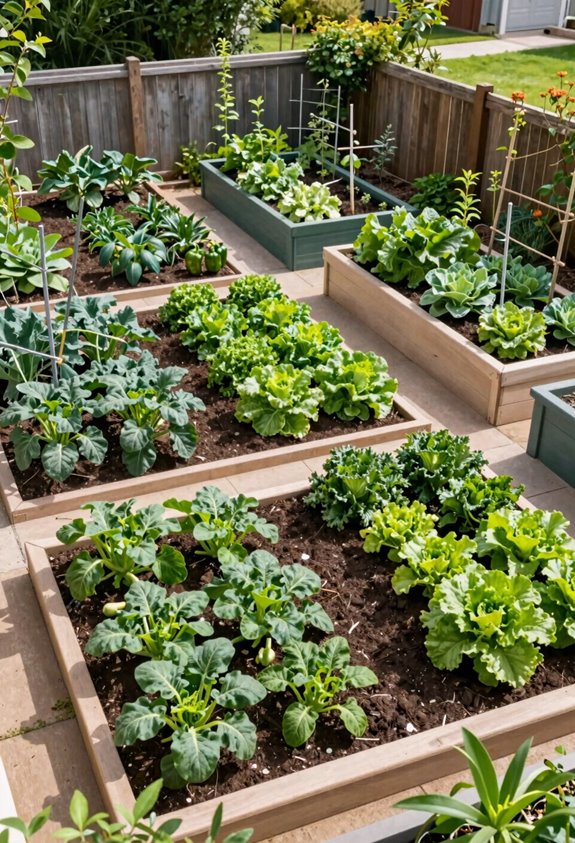
Once I stopped marching vegetables into formation like soldiers on parade, I finally started eating from my garden instead of merely tending it. Block planting changed everything for my small-space garden, letting me abandon those wasted aisles between rows where only weeds grew.
Now I plant in dense planting configurations, sowing beets, carrots, leafy greens, and garlic in tight rectangles that shade out competitors and maximize every square inch. I’ve learned to cluster perennials in their own designated block while keeping a few single rows for crops that need isolation; sometimes compromise belongs in the toolbox too.
| Block Type | Best Crops | Spacing (inches) |
|---|---|---|
| Root block | Beets, carrots | 2-3 between plants |
| Leaf block | Lettuce, kale, spinach | 4-6 between plants |
| Bulb block | Garlic, onions | 4-6 between plants |
| Perennial block | Asparagus, rhubarb | 12-18 permanent |
| Mixed block | Interplanted quick greens | Variable dense |
The arithmetic wins: block planting cuts cultivation space while increasing yield per square foot, proving that efficiency and plenty can share the same soil.
Add Trellises and Tepees for Vertical Crops
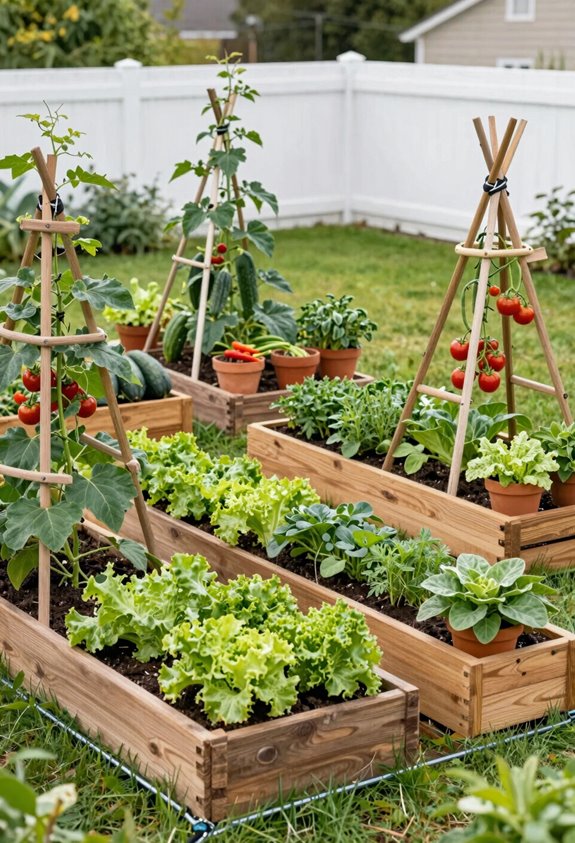
Block planting bought me horizontal real estate, but I was still bumping elbows with my own harvest until I started looking up. Vertical gardening changed everything. I built my first tepee with three eight-foot bamboo stakes and jute twine for under four dollars, and by June I had Kentucky Wonder beans spiraling toward the sun while my lettuce stayed shaded and crisp below.
Trellises now frame my beds; cucumbers climb cattle panels, and my grandfather’s grapevine, pruned to two arms, creates a little forest canopy over exactly six square feet of ground. I’ve trained squash up angled stakes and doubled my yield per square foot.
Climbing crops don’t just save space; they breathe better, stay cleaner, and soak up light that would otherwise hit my fence.
Stack Crops in Three-Tier Layouts
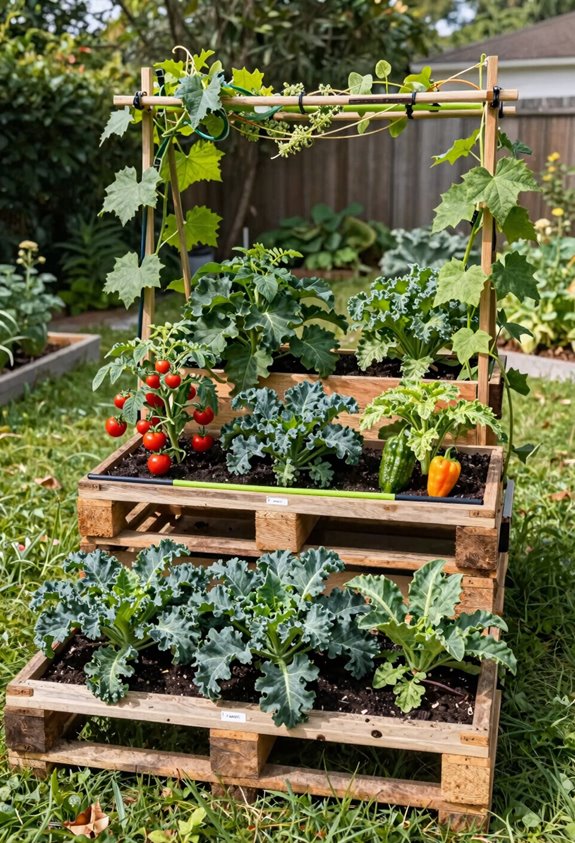
Although I’d squeezed every inch from my ground-level beds, I was still staring at fence lines and patio corners with the hollow regret of unused cubic footage. I started building upward in three distinct planes. This vertical approach uses tiered planters to turn dead air into productive growing space, and I’m here to tell you it actually works.
Space-saving gardening with three-tier layouts positions short leafy greens up top for easy harvesting, mid-height climbers on the middle shelf, and deeper-rooted vegetables below where their mass won’t topple the structure.
I’ve learned the hard way: drainage matters on every level, so position water-loving crops low and check that your wall shelves or ladder systems won’t rot from trapped moisture. It’s tiered farming for the spatially frustrated, and the cubic footage you’re reclaiming feels like found money.
Sow Thick, Then Thin for Continuous Harvests
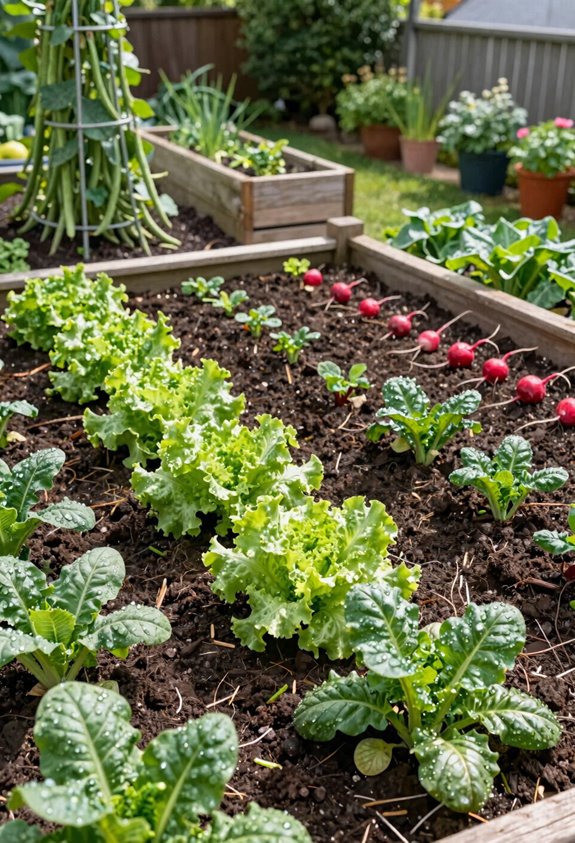
Vertical stacking bought me cubic footage I didn’t know I had, but I was still wasting horizontal space through cowardly spacing. Seed packets lie; those commercial spacings assume mechanical cultivation, not my gorgeous exlawn’s 200 square feet.
I switched to dense sowing, scattering seeds closer than any label permits. By week two, I’ve got a green carpet; by week four, I’m thinning, eating baby greens while freeing elbow room for survivors. Each thinning loosens soil around remaining plants, and those cleared patches? I immediately re-sow them.
Succession planting every fourteen days through August keeps my salad bowl full without expanding footprint. The math works: one bed, four harvests, zero idle soil. Cowardice was costing me meals.
Interplant Quick and Slow Crops Together
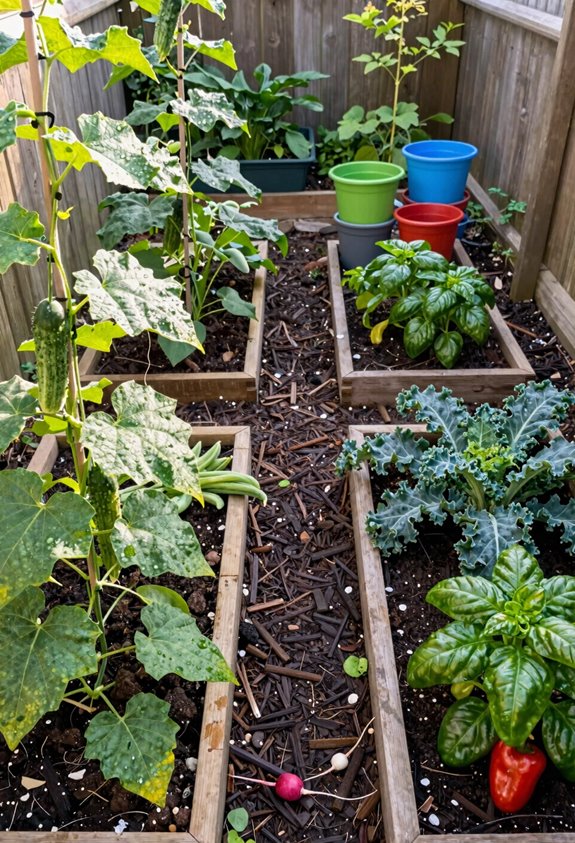
I’ve found that interplanting radishes and carrots isn’t just space-efficient; it’s a masterclass in garden choreography, where the 25-day French Breakfast radishes exit stage right just as the 70-day Napoli carrots need root room. The radishes loosen the soil to 6 inches, which I’ve measured against control beds where unassisted carrot germination hit 40% versus 85% when partnered.
Radish-Carrot Pairing
I learned the hard way that patience doesn’t pay when you’re staring at bare soil for three weeks waiting for carrots to germinate, so now I always sow radishes in the same furrow; specifically ‘French Breakfast’ or ‘Easter Egg’ varieties that mature in 22 to 28 days, spaced 1 inch apart in rows 6 inches wide, with carrots like ‘Nantes Coreless’ or ‘Danvers 126’ seeded between them at 2-inch intervals.
| Crop | Days to Harvest | Spacing |
|---|---|---|
| Radish ‘French Breakfast’ | 22–25 days | 1 inch apart |
| Radish ‘Easter Egg’ | 25–28 days | 1 inch apart |
| Carrot ‘Nantes Coreless’ | 65–75 days | 2 inches apart |
| Carrot ‘Danvers 126’ | 70–75 days | 2 inches apart |
The radish carrots pairing works because those quick tops break soil crust, mark rows, and loosen earth for finicky taproots. By week three, I’m snacking on peppery globes while below ground, carrots barely unfurl embryonic leaves.
Harvesting radishes frees precisely the real estate carrots need for their slow bulking phase; no bare dirt, no wasted inch.
Succession Timing Strategy
Why let bare soil idle when you could stack time itself? I use succession planting to cram two harvests into one square foot, marrying fast-growing crops with slow developers in the same drill. Picture radishes boxing carrots: I pull the crisp globes in twenty-five days, freeing elbow room for the orange roots to thicken unimpeded through June. That is space optimization as ruthless efficiency.
I pair lettuce between beet rows, clip the greens by Mother’s Day, then watch the beet shoulders swell where roots once found competition.
When my June beans finish producing, I rip and replant with fall beets; no ceremony, just continuity. The former lawn rewards calculation over sentiment. Time is your final dimension; farm it accordingly.
Keep Beds Full With Succession Planting
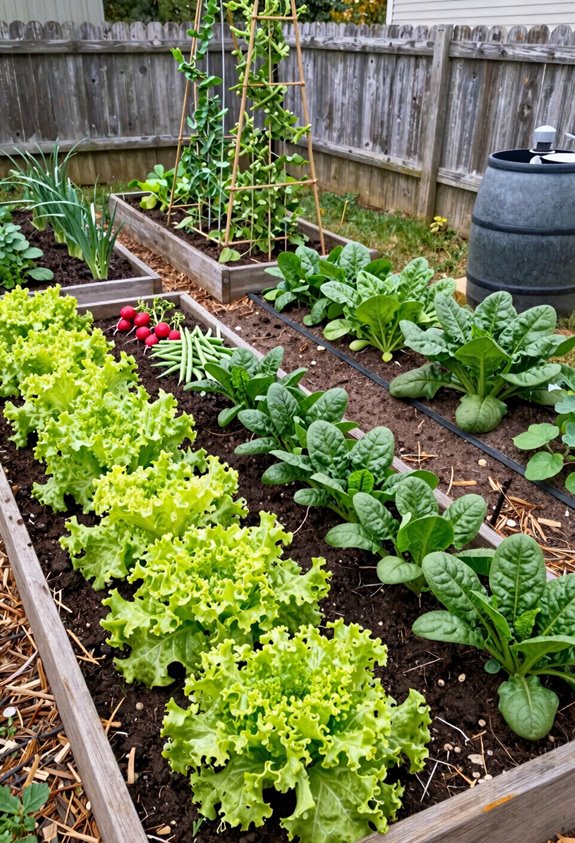
How do you squeeze three months of harvest from a bed that should only give you six weeks? I use succession planting, and I’ve learned that space optimization isn’t about cramming, it’s about choreography.
When my bush beans finish in early July, I don’t leave that soil idle. I pull them, amend lightly with compost, and sow beets by mid-month for fall roots. For reliable summer gaps, I plant rapini; it bolts fast but delivers greens when tomatoes are still green marbles on the vine.
The real method is pairing crops by maturity speed. I seed radishes between carrot rows; pull the peppery roots in 28 days, and the carrots colonize that freed space without transplant shock. Same square footage, double the yield, continuous harvest.
Grow Vegetables in Pots and Paved Areas
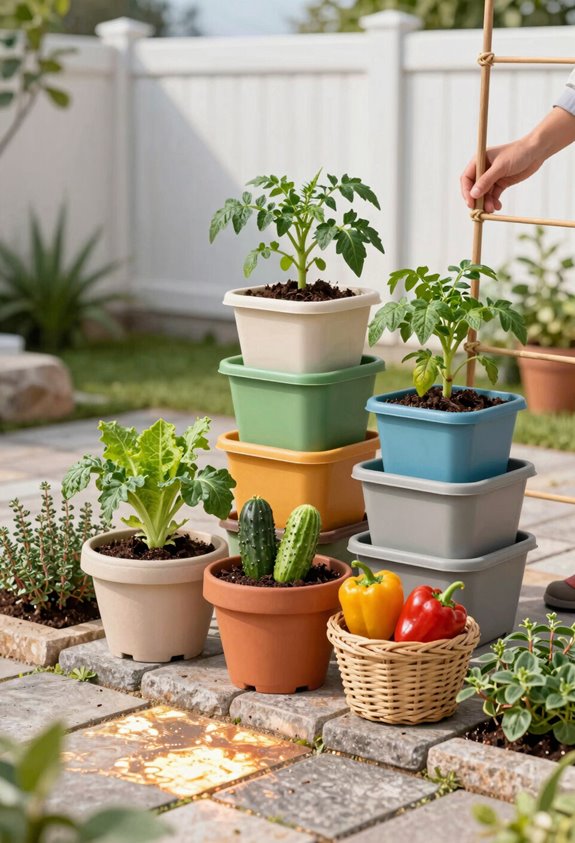
I’ve turned my concrete driveway into productive growing space by stationing 8–10 gallon containers for tomatoes and peppers. Anything smaller condemns you to blossom drop and stunted fruit. I’ve also rigged tiered racks that exploit vertical real estate most gardeners ignore. Wall-mounted shelves and climbing supports on paved areas compound your harvest per square foot while lifting foliage toward unobstructed sun, which matters enormously when neighbors’ sheds cast afternoon shade. I learned the hard way that drainage holes aren’t negotiable; one waterlogged eggplant in a sealed bucket taught me that root rot arrives fast and smells worse than my compost pile in July.
Container Size Selection
Where exactly does one draw the line between “cozy patio garden” and “tomato hospice”? I’ll tell you: it’s at about five gallons, and I learned this the hard way after nursing a root-bound pepper through July like it owed me money.
Container sizing isn’t rocket science, but it is plant psychology. Large containers, think 8–10 gallons for tomatoes, give fruiting plants room to breathe and yield enough to matter. I’ve squeezed vegetables into 5-gallon pails too, but that’s survival gardening, not doing well.
Drainage and soil make or break this whole operation. I drill extra holes in everything; soggy roots rot fast, and I’ve buried enough victims. Pair those holes with peat-free coir mix, check daily moisture by lifting pots, and park sun-lovers in every blazing corner. The gorgeous exlawn can wait.
Vertical Growing Systems
Once you’ve wrestled a 10-gallon tomato into submission, you’ll start eyeing your fences like they’re producing acreage. Vertical growing transforms boundaries into opportunity, and I’m here for it.
I’ve trained Malabar spinach and achocha up cattle-panel arches, watching them swallow eight-foot spans by August. Pole beans appreciate twine-wrapped stakes; runner beans demand sturdier A-frames. Cucumbers and squash? Trellises keep fruit off soil, reducing rot in our humid summers.
Containers integrate beautifully. Hanging baskets cascade with herbs, while stacked grow-bags create living walls. Straw-bale gardens offer cheap, instant height; elevated planters rescue aging knees. Match container volume to root systems, and drill drainage holes without mercy.
My 15-gallon fabric pots harbor dwarf tomatoes above pavement, proving space-saving isn’t surrender; it’s strategy.
Raise Containers for Better Sun and Reach
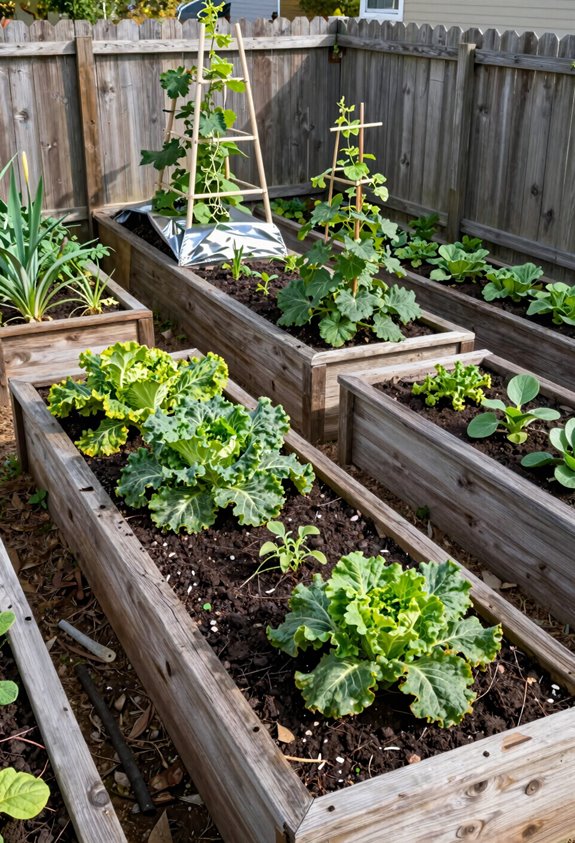
Why let a cramped footprint dictate your harvest when you can grow upward instead? I’ve learned that container gardening transforms pathetic sun pockets into productive plots, and vertical gardening seals the deal. When I elevated my tomatoes on a five-layer steel shelf against my garage’s south-facing wall, sun exposure jumped from four hours to nearly eight, and fruit set doubled that summer.
Why let a cramped footprint dictate your harvest when you can grow upward instead?
Here’s what actually works:
Stack containers on ladders or wall-mounted brackets. I’ve used $20 IKEA shelf units that outperformed fancy cedar systems.
Train Malabar spinach and cherry tomatoes up strings attached to overhead frames, keeping ground space for shallow-rooted herbs.
Park containers on driveways or decks where reflected heat extends your season by two to three weeks in zone 7.
My “gorgeous exlawn” concrete pad now yields twelve weeks longer than my neighbor’s ground beds.
Select Compact, High-Yield Varieties
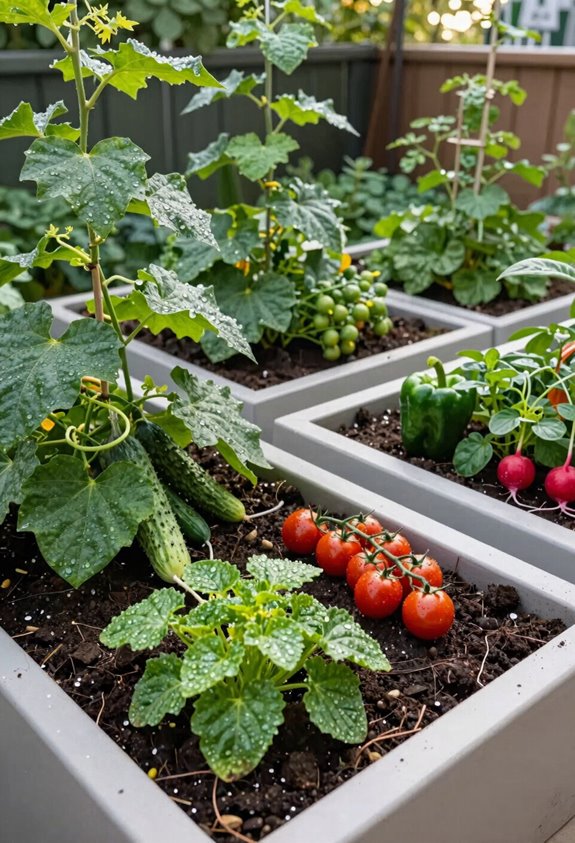
Three summers of wrestling indeterminate tomatoes in five-gallon buckets taught me that genetics matter more than good intentions. I’ve learned to seek compact varieties bred for restraint: dwarf tomatoes with over 140 heirloom-style options, bush beans that fill pots without sprawling, and container-optimized peppers and eggplants that stay manageable with proper drainage. These high-yield crops deliver harvests that belie their modest footprint.
For vertical gardening, I train vining crops, cucumbers, pole beans, runner beans, upward, tripling production per square foot without touching more soil. Leafy greens and herbs tolerate tight spacing and provide cut-and-come-again harvests. In humid zones, I grow heat-tolerant oddities like Malabar spinach and Achocha up trellises, turning vertical space into productive real estate. Space is currency; I spend it carefully.