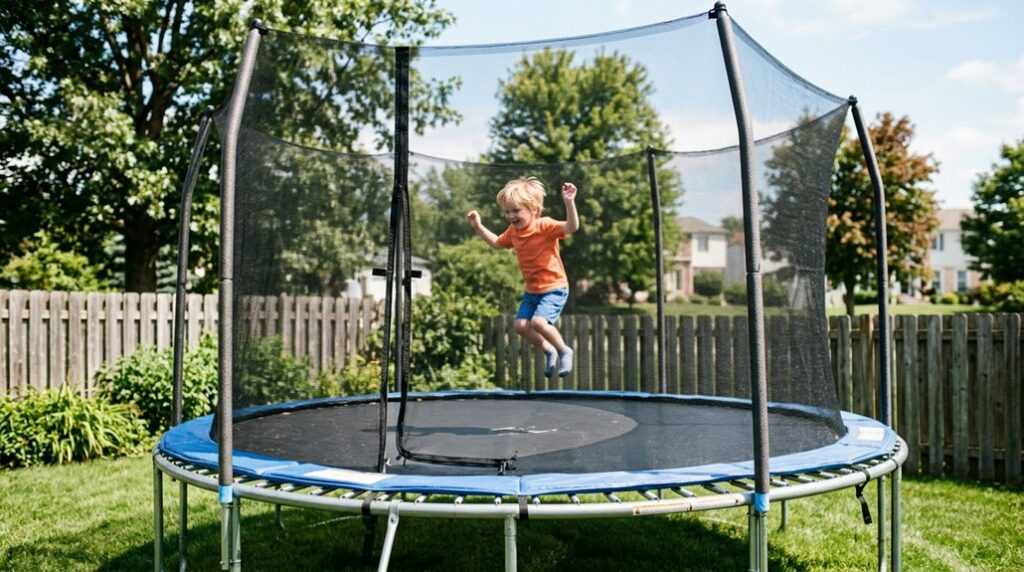
Icarus had his wings; my kids had a 14-foot Skywalker with a “safety” net that lasted one summer before the zip split. I’ve buried two frames in Zone 6 clay, $400 each, 6 hours assembly, three trips to urgent care.
The American Academy of Pediatrics won’t budge: backyard trampolines are equipment. You want to know what actually breaks, and whether those nets are worth the polyester they’re sewn from. I kept receipts.
How Common Are Trampoline Injuries, Really?
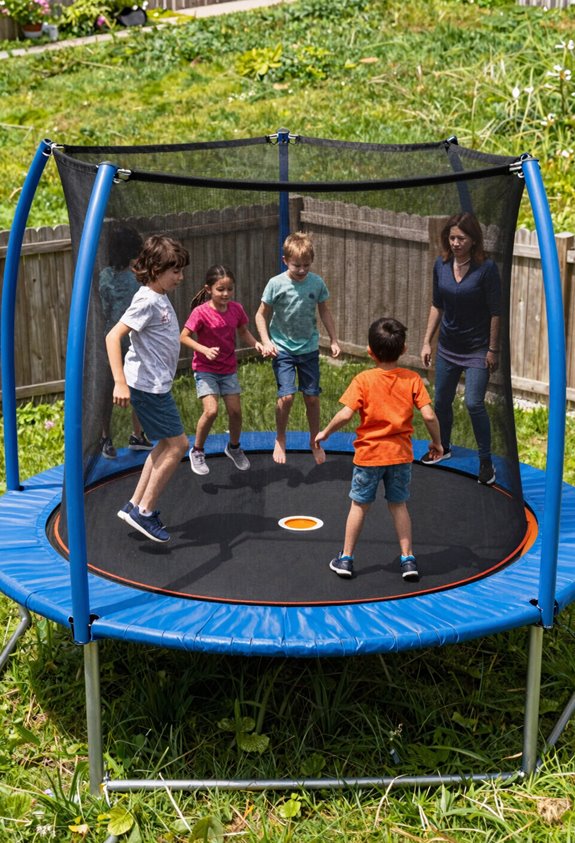
Just how risky is that springy rectangle in your neighbor’s gorgeous ex-lawn? I’ve looked into injury prevalence data, and the numbers aren’t encouraging. Between 2009 and 2018, over 800,000 kids landed in the emergency department with trampoline injuries, nearly 100,000 children annually. Pediatric fractures dominate the tally at 34–49% of cases, with elbows and forearms snapping like greenhouse twigs under late frost.
Head and neck injuries, including concussions, add another layer of worry. The American Academy of Pediatrics has issued safety guidelines, yet backyard trampolines keep claiming victims, mostly from falls on the mat itself with multiple jumpers aboard. If you’re weighing that purchase, know the risks run deeper than a poorly drained raised bed.
Common Injury Patterns on Trampolines
| Injury Type | Typical Cause | Prevention Focus |
|---|---|---|
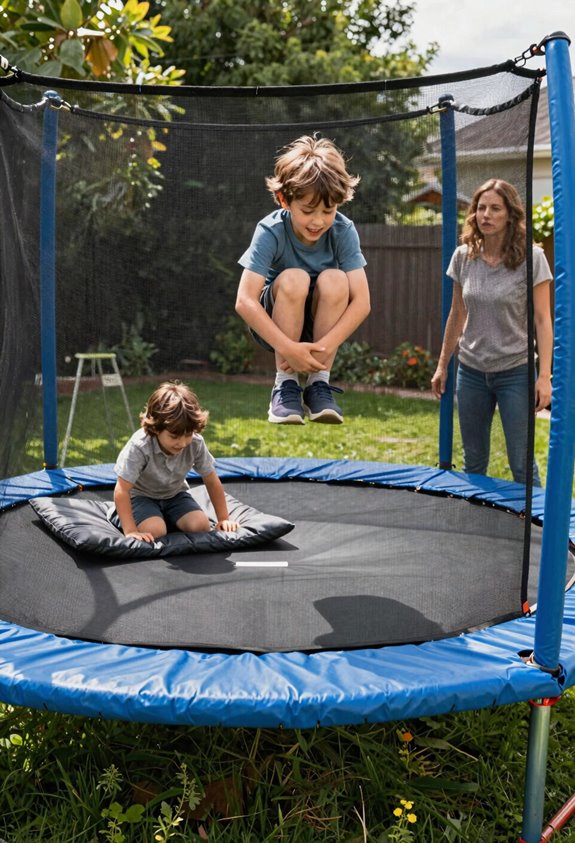
| Fractures (91%) | Mat falls, awkward landings | One jumper rule |
| Head and neck injuries (20%) | Collisions, falls off edge | Enclosure nets, ground clearance |
| Soft tissue injuries | Multiple jumpers, double-bounces | Supervision, age separation |
The Worst Injuries Kids Get on Trampolines
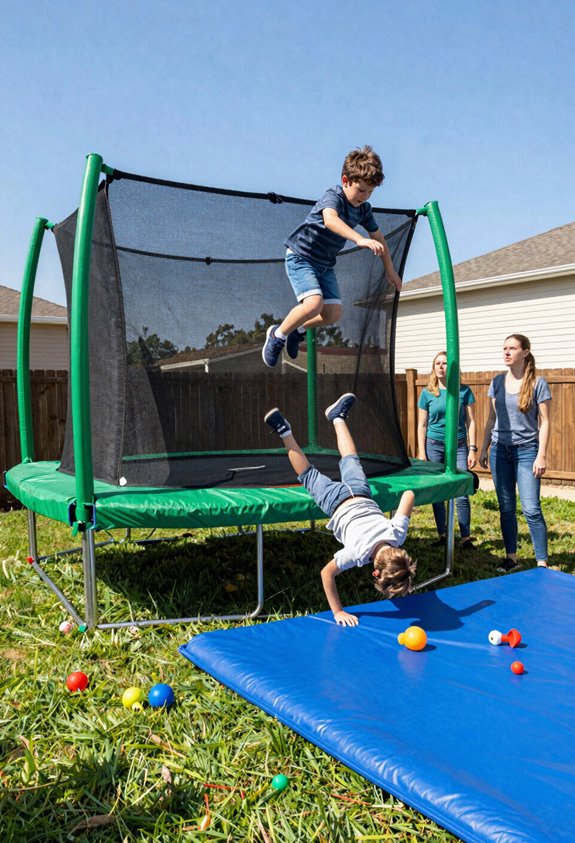
I’ve seen enough x-rays to know that “fracture” barely covers what’s happening when a kid lands wrong on a trampoline. We’re talking about severe elbow and forearm breaks that require surgical pinning, plus the spinal injuries that don’t heal like a bruised tomato vine: cervical compression fractures and vertebral dislocations that can leave a child paralyzed from the neck down, no matter how soft your lawn looks from three feet up.
These aren’t rare outliers either. They’re the predictable harvest when you plant high kinetic energy and immature bone structure in the same bed.
Severe Fracture Patterns
Why do so many kids end up with hardware in their elbows after a birthday party bounce session? I’ve seen trampoline injuries turn ordinary afternoons into ER nightmares, and elbow fractures dominate the chaos, about 34% of pediatric fractures, with forearm fractures adding another 21%. These severe fractures often demand hospital admission and surgery, especially when multiple kids collide or younger ones under six tumble off.
| Fracture Type | Percentage | Typical Cause |
|---|---|---|
| Elbow fractures | 34% | Falls onto outstretched arm |
| Forearm fractures | 21% | Collision with another child |
| Cervical spine injuries | Low but severe | Awkward landing on neck |
| Upper-extremity overall | 32-75% | Variable impact forces |
Cervical spine injuries, though rarer, haunt orthopedic surgeons. Safety precautions aren’t optional; they’re the difference between a bounce and a hardware installation.
Life-Altering Spinal Injuries
Fractures heal, but a snapped cervical vertebra doesn’t forgive. I’ve watched trampoline-related cervical spine injuries turn playground dreams into wheelchair realities, and I’m not overstating the pediatric risk to frighten you; I’m documenting what 12% of hospital admissions actually involve.
You think supervision limits guard against catastrophe? I’ve seen flying injuries shatter tenth cervical vertebrae while parents monitored from patio chairs. Multi-child environments compound the danger; kinetic energy transfers unpredictably, and collision physics don’t care about your six-foot safety net.
Injury prevention demands acknowledging what padding cannot fix. When three kids synchronize their bounce, collision force spikes exponentially; vertebral artery dissection becomes a real possibility. The lawn of your backyard hides surgical intervention probabilities that compound with each additional jumper.
I’ve learned yards deserve respect, and so do cervical spines.
The Pediatrician’s Case Against Backyard Trampolines
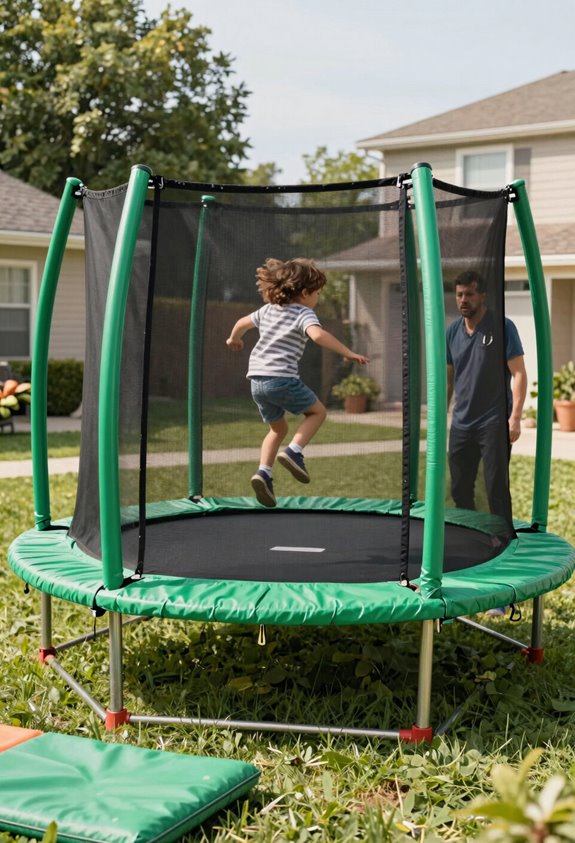
I can’t help but notice the numbers first: roughly 100,000 American kids hit pediatric trauma centers annually from trampoline injuries, with 91% showing up with fractures or worse. The American Academy of Pediatrics isn’t whispering these warnings, it’s shouting them, and I’m inclined to listen when 99% of cases land in the moderate-to-severe category.
When professional bodies line up this uniformly against backyard equipment, I start wondering if my “supervised” setup is just a prettier version of the same risk.
Alarming Injury Statistics
How often do we plant something in the backyard expecting joy and harvest instead a trip to the ER? I’ve watched my gorgeous exlawn transform from a blank slate to a minefield, and here’s what the data shows me.
Each year, roughly 100,000 kids suffer trampoline injuries on backyard trampolines, with most happening at home or a neighbor’s. I’m talking fractures, 34% elbow, 21% forearm, 15% tibia/fibula, plus head injuries striking more than one in five children. Nearly every case in trauma centers registers as moderate or severe, and most need hospital care.
I’ve tried safety guidelines like supervision and single-user rules, but they haven’t reduced injury severity in research. The pediatricians have it right: the injury risk is baked into the apparatus itself, no matter how we prune around the edges.
Professional Medical Warnings
The numbers I just laid out aren’t coming from alarmists on parenting forums; they’re the official stance of the American Academy of Pediatrics, which has advised against home trampolines entirely since 2012 and reaffirmed that position in 2022.
I’m not here to sugarcoat it: pediatric safety data doesn’t favor backyard trampolines. About 100,000 kids get injured annually, with 91% being fractures; some requiring surgery. Most injuries happen right at home, often with multiple jumpers, and it’s worth noting that falls on the mat, not off it, cause the damage.
| Safety Measure | Reality Check | My Take |
|---|---|---|
| Supervision | Even with eyes on kids, injury risk persists | Doesn’t eliminate fractures |
| Safety nets padding | Research indicates no significant reduction in severity | False security blanket |
| Age restrictions | Under 6 faces highest risk | Skip entirely for younger kids |
Somersaults and flips multiply the danger. Safety nets and padding won’t save a neck. I’ve seen beautiful former lawns become emergency room launchpads. The evidence is clear: backyard trampolines simply don’t meet pediatric safety standards, supervision or not.
Are Trampoline Parks Safer Than Backyards?
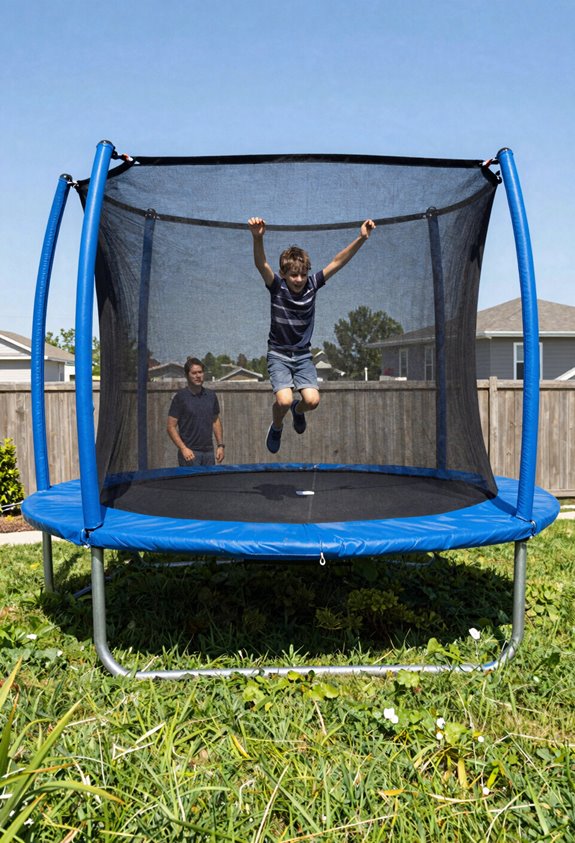
When you’re weighing whether to haul the kids to that gleaming warehouse of spring-loaded floors or let them bounce on the rickety oval your neighbor offloaded for fifty bucks, the answer isn’t as straightforward as the marketing brochures suggest. I’ve pored over the data, and here’s what jumps out: trampoline parks carry injury risk that rivals, or exceeds, backyard trampolines.
Those massive interconnected surfaces breed chaos; multiple jumpers collide mid-air, and the extra spring launches kids higher than any domestic model. Safety supervision at parks looks impressive with neon-vested attendants, but they’re outnumbered and undertrained. The social pressure to attempt flips and somersaults spikes in that echoing arena, and pediatric safety statistics confirm my suspicion: surgery risk runs higher when limbs tangle on shared mats.
Belonging to the “smart parent” tribe means recognizing that controlled home environments, with vigilant eyes and enforced rules, often outperform commercial spectacle.
Do Safety Nets and Padding Actually Prevent Injuries?
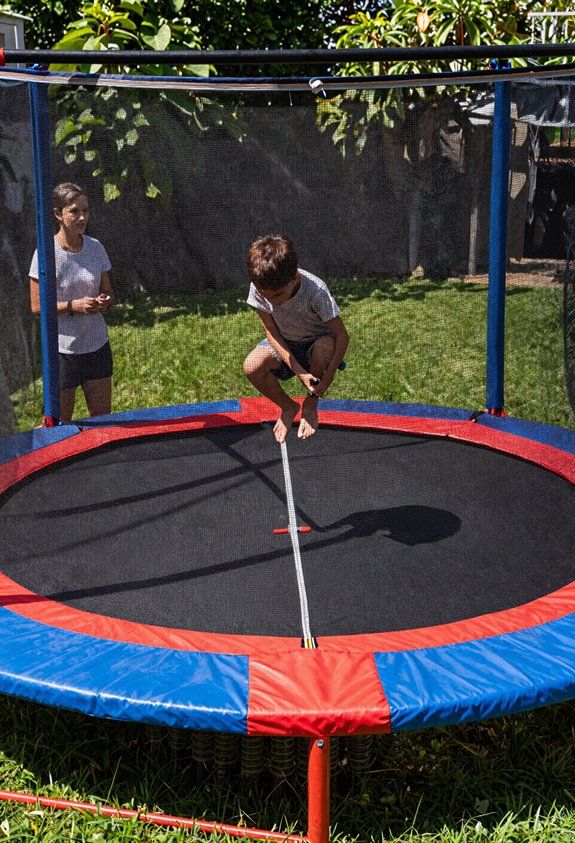
Why do we cling to netting like it’s magical force field when physics tells a different story? I’ve researched safety nets and padding extensively, and here’s what I found: protective equipment existed in only fifty-five percent of trampoline injuries in one major study. Injury prevention isn’t guaranteed.
Most trampoline injuries occur on the mat itself or from falls when multiple jumpers collide. Padding covers the springs, but it won’t cushion a botched landing or prevent two kids from cracking skulls mid-bounce. Park vs backyard? Park settings often mean higher bounces and worse outcomes despite nets.
Even with complete protective equipment, I’ve seen data showing fractures, head trauma, and surgical cases. The equipment reduces some risks, but it doesn’t eliminate severe injury. Physics wins every time.
Reducing Risks If You Install a Trampoline at Home
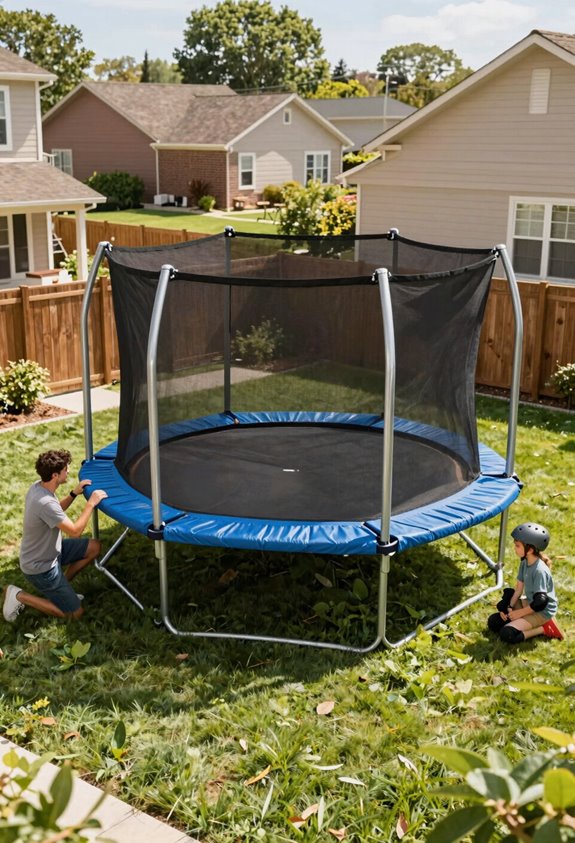
Because I’ve buried enough skinned knees in the backyard to know better, I won’t pretend you can trampoline-proof childhood, but you can certainly hedge your bets. I’ve learned that trampolines demand respect, not wishful thinking.
Start with safe setup: flat ground, three to five feet of clearance, and please, check your weight ratings like you’re reading seed packets. I always remove the ladder when play ends; unsupervised access invites disaster.
Safety nets matter, but I pair them with one jumper at a time and constant supervision. No exceptions. My padding and padding inspection schedule runs monthly; UV damage sneaks up like crabgrass.
Springless designs or enclosed rebounders minimize exposure risks. Inspect frames, nets, and padding regularly. You’re not building a playground utopia, just managing injury risk with elbow grease and rules worth following.
Lower-Risk Activities That Replace Trampoline Play
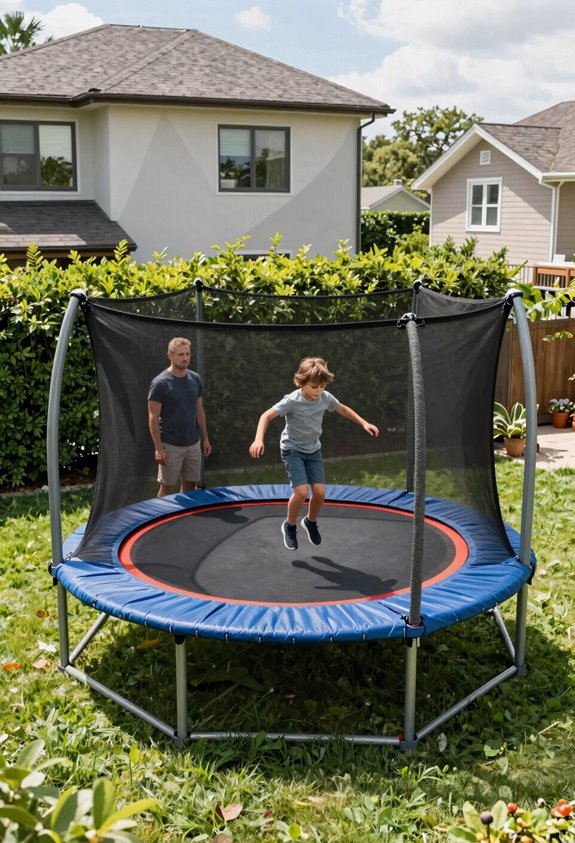
I’ve hedged my bets with netting and one-at-a-time rules, but sometimes the smartest play is swapping the risk entirely. When trampoline safety keeps me up at night, I pivot to lower-risk activities that still burn energy and build skills. My safety recommendations favor supervised play with age-appropriate alternatives: mini trampolines with handlebars for toddlers, or enclosed trampolines with springless designs for bigger kids.
I also embrace non-jumping outdoor activities: low climbing walls, balance beams, and compact playsets under 24 inches. These deliver coordination gains without the spinal roulette.
| Option | Best For | Key Safety Feature |
|---|---|---|
| Mini trampolines | Ages 2–5 | Handlebars, flat surfaces |
| Enclosed rebounders | Ages 6–10 | Low platform, netting |
| Springless designs | All ages | Soft edges, no pinch points |
| Climbing walls | Ages 4+ | Low height, padded base |
| Structured games | Mixed ages | Adult supervision always |