I once watched a $4,000 grill crash through rotted cedar decking like it was wet cardboard, yet I’ve also built a deck kitchen that’s survived six Minnesota winters without a wobble. The difference isn’t luck. It’s load capacity, which most homeowners eyeball badly.
Your joists might handle a dinner party, but will they bear 800 pounds of stone countertop plus three tipsy uncles? I’ll walk you through the math that keeps your investment above ground.
Can Your Deck Actually Support an Outdoor Kitchen?
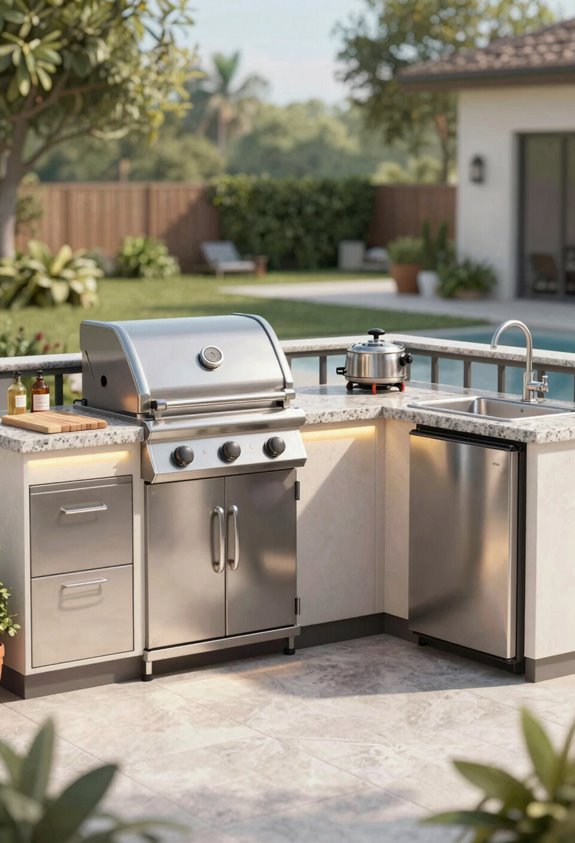
How much weight can your deck really shoulder before it groans? I’ve learned the hard way that most residential decks carry a deck load rating of roughly 50 PSF combined live load and dead load, barely enough for your gorgeous exlawn furniture, let alone an outdoor kitchen.
Before you haul in heavy appliances, verify your joist size and spacing. I once watched a friend’s stone countertop crack his ledger board because he skipped this step. Structural reinforcement isn’t optional when you’re stacking refrigerators and pizza ovens overhead.
Heavier components like concrete panels spike live load dramatically. I’ve seen decks fail where owners assumed “it looks sturdy” sufficed. Don’t be that person. A structural engineer costs $300–$800, but they’ll confirm whether your existing framework needs sistered joists, steel brackets, or complete rebuild.
Which Deck Materials Work Best for Heavy Appliances?
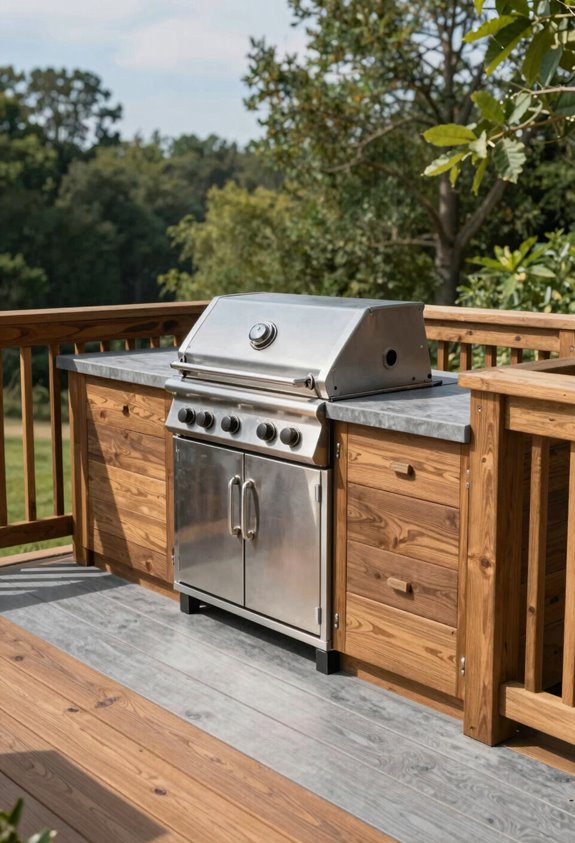
I’ve worked with composite decking enough to know it’s my go-to recommendation for deck-top kitchens; brands like Trex and Fiberon shrug off grease splatters and resist combustion far better than raw lumber, though you’ll still pay a premium at roughly $4–$12 per square foot.
Pressure-treated pine’ll save you half that cost upfront, but I’ve watched too many gorgeous exlawns turn into splintered warping nightmares when owners skipped the annual sealing ritual their USDA Zone 7 winters demanded.
Whichever surface you choose, remember that your 50 PSF-rated deck wasn’t engineered for flagstone countertops or that 400-pound ceramic smoker; you’re looking at joist sistering and possibly a structural engineer’s $500 consultation before the first burger hits the grate.
Composite Decking Advantages
Why settle for a kitchen that demands constant babysitting when composite decking lets you actually cook without the wood rot anxiety? I’ve watched neighbors replace warped cedar three times while my Trex surface shrugs off grease spills like a duck’s back.
Composite decking blends wood fibers with plastics, delivering serious weight support for granite countertops and beefy grills without the sagging drama. Manufacturers like Fiberon and TimberTech engineer these boards with built-in moisture resistance, so your outdoor kitchens won’t become fungal petri dishes after spring rains.
The maintenance practically disappears; no annual sanding marathons, no staining weekends lost forever. I check manufacturer temperature guidelines before placing my pizza oven; prolonged scorching can still damage the surface. But for durability that lets you belong to the cooking-not-repairing crowd, composite wins.
Pressure-Treated Considerations
Composite decking handles the easy life, but pressure-treated lumber still carries the weight when you’re pinching pennies or building big. I’ve built both ways, and pressure-treated wood gets you started at roughly $15-$25 per square foot versus composite’s $40-$60, real money when you’re spanning a gorgeous exlawn in USDA Zone 7 like mine.
But here’s the rub: outdoor kitchen appliances crush standard joists. I learned this installing a 400-pound grill island; my deck’s load capacity needed reinforcement with sistered 2x10s and extra posts set in concrete below frost line.
Fire safety demands respect too. I’m talking fire-rated stone pads under your cooktop, not prayer. Skip deck maintenance, sealing every 18-24 months against moisture and pests, and you’ll watch warping ruin your setup by year three. Consult a structural engineer; my pride has cost me plenty.
When Does Your Deck Need a Structural Engineer?
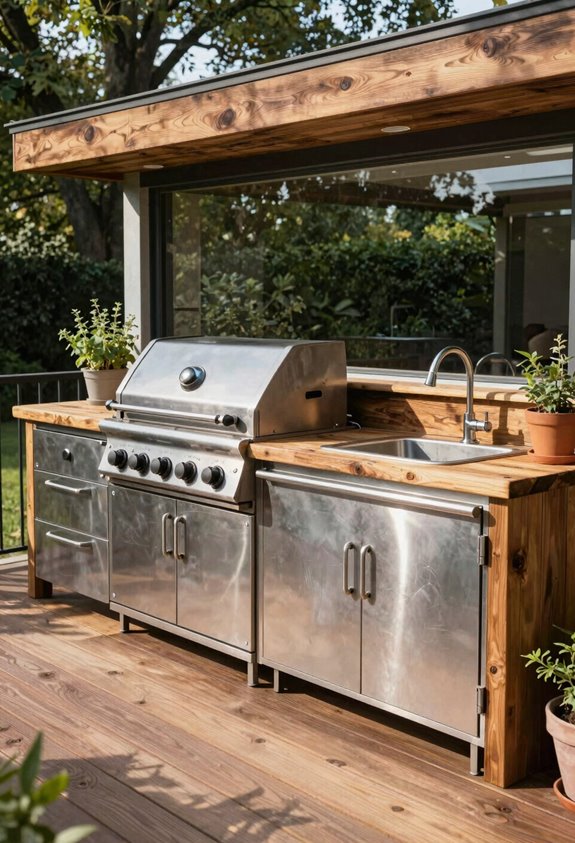
How heavy is too heavy when I’m eyeing that gorgeous stone countertop for my deck kitchen? I’ve learned the hard way that “probably fine” isn’t an engineering standard.
I consult a structural engineer when my live loads push past that typical 50 PSF rating. Stone panels and built-in appliances aren’t forgiving. They evaluate my joist size and spacing, check whether my footings can handle concentrated weight, and determine if deck reinforcement saves me from disaster.
For my own build, I upgraded joist size and added steel brackets after the engineer flagged my ledger board. That formal evaluation ensured code compliance and caught deterioration I’d missed.
Don’t skip this step. Your gorgeous outdoor kitchen deserves a foundation that won’t sag, crack, or collapse mid-burger.
Should You Choose Modular or Built-In Cabinets?
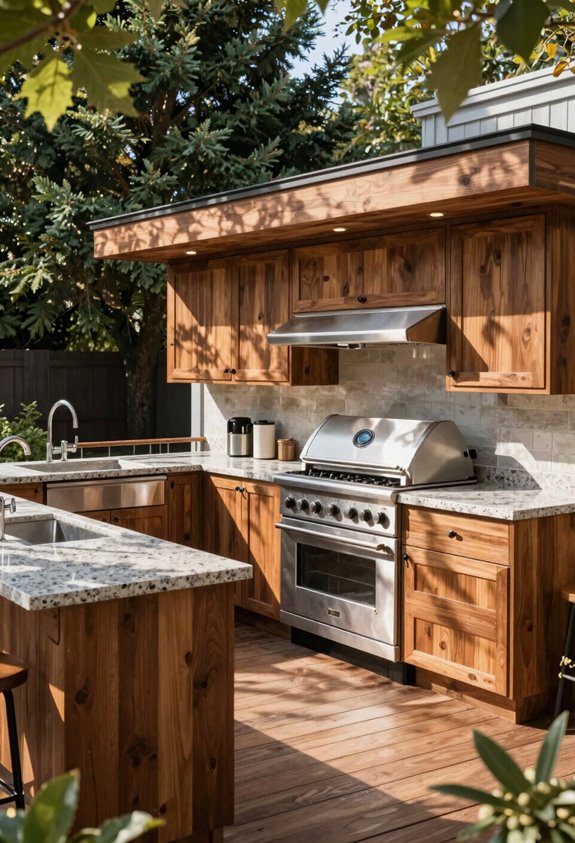
I’ve weighed this choice on my own deck twice, first with a modular aluminum system I assembled in a weekend for roughly $3,200, and later with built-ins that took three weeks and nearly tripled the cost but earned me permanent barbecue cred. Modular cabinets let you reconfigure your layout faster than you can rotate a container garden through USDA hardiness zones, while built-ins reward your permanence with seamless countertops and that gorgeous exlawn-worthy integration.
Your decision hinges on whether you value future flexibility above all else, or if you’re ready to commit your deck’s real estate the way I finally committed my tomatoes to raised beds, roots and all.
Modular Cabinet Benefits
Why wrestle with permanent masonry when your cooking ambitions might outgrow next season’s menu? I’ve learned that modular cabinets let you build your outdoor kitchen like Lego for grown-ups: snap together, tear apart, rebuild.
These lightweight systems, typically aluminum or composite panels, spare your deck load the punishment of poured concrete or stacked stone. I installed my first set in Zone 7b on 12-foot pressure-treated joists; total weight stayed under 400 pounds versus two tons for masonry. Corrosion resistance matters when morning dew meets grill grease, and aluminum delivers. The reconfigurable layout adapts when you upgrade from a two-burner to a six-burner monster or add that kamado you’ve been eyeing. No contractors, no permits, no regrets.
Built-In Cabinet Advantages
The permanence of built-in cabinets carries its own seductive logic, and I’ll admit, after three seasons of reconfiguring my modular setup like an obsessive Tetris player, I started envying neighbors whose kitchens didn’t wobble in high winds. Built-in cabinets anchor your outdoor kitchen cabinets to something real; they don’t drift like my old aluminum units after every thunderstorm.
You’ll want stainless steel for corrosion resistance, my coastal cousin learned this the hard way in Zone 9b, and weather-resistant hardware that won’t seize after one humid July. Concrete countertops add heft and gorgeous endurance, though they’ll demand deck reinforcement; I consulted an engineer before installing 400 pounds of limestone and steel. The weight distributes properly, and suddenly you’re cooking in something that feels like it belongs there.
Key Decision Factors
How exactly do you choose between cabinets that bolt down forever and ones you can drag around like patio furniture? I’ve wrestled with this on my own cedar deck, and it boils down to balancing permanence against flexibility, plus what your joists can actually handle.
- Outdoor kitchen weight determines whether you’ll need deck reinforcement before placing that 400-pound grill island
- Built-in cabinets integrate seamlessly but demand professional installation and structural upgrades
- Modular cabinetry lets you reconfigure layouts seasonally without permits or concrete footings
- Local codes often require inspections for permanent structures, while freestanding units slip through bureaucratic cracks
I learned this the hard way: my stone-topped built-in required sistering every joist, but my neighbor’s aluminum modular system went up in an afternoon. For heavy outdoor appliances, calculate load per square foot. Your gorgeous exlawn won’t forgive a collapsed cantilever.
Which Utilities Can Your Deck Kitchen Actually Reach?
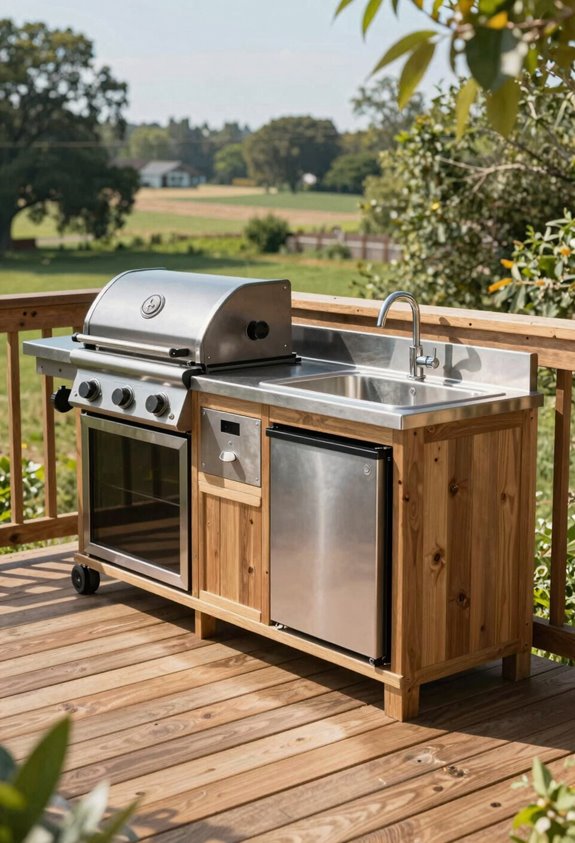
Where exactly your utilities can reach depends on what you’re willing to trench, insulate, and pay a licensed professional to sign off on. I learned this the hard way after burying a water line too shallow one October and listening to it freeze solid before Thanksgiving. I’ve since found that proper water lines need frost-level burial with insulation, especially in USDA zones 5 and below, where 30-inch depths aren’t unusual.
Gas grills need either propane tanks or natural gas hookups, but here’s the catch: that second option means a license required, full stop, and you’ll pay roughly $15-25 per square foot run for the privilege. Wiring and outlets need GFCIs, grounded circuits, and another licensed professional. Smart planning tucks underground utilities under the deck with recessed boxes, keeping your gorgeous exlawn intact while keeping you connected.
What Fire Safety Rules Apply to Deck Kitchens?
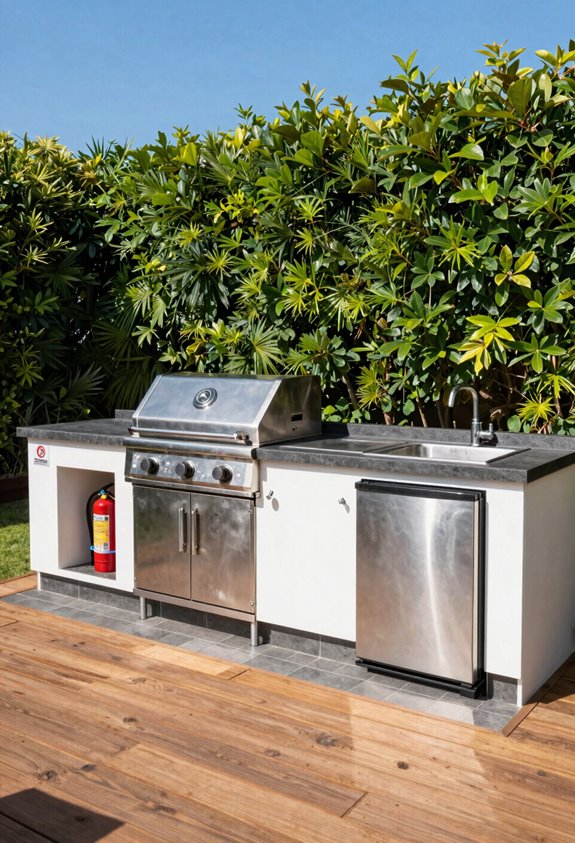
Why do so many deck kitchens char their owner’s pride along with the burgers? I’ve watched neighbors learn the hard way that fire safety isn’t optional when you’re cooking above combustible decking.
Here’s what keeps us all in the community of unscathed hosts:
Respect clearances: I keep grills ten feet from siding and branches, because embers don’t RSVP.
Choose non-combustible materials for surrounds; my stone backsplash laughs at grease splatter.
Install decking protection, fire-rated mats or stone pads under heat sources save gorgeous ex-lawns from becoming gorgeous ex-decks.
Mind venting/placement; crosswinds carry sparks farther than you’d guess.
Don’t store propane or leaves beneath your deck. For deck-top builds, I always loop in a licensed professional; codes vary by municipality, and my trial-and-error budget has limits.
How Do You Weatherproof a Deck Outdoor Kitchen?
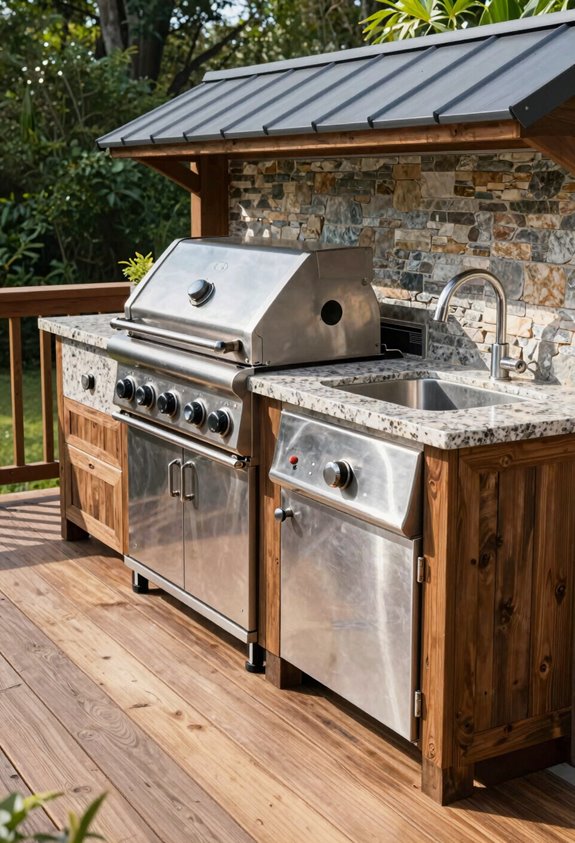
Perhaps you’ve already dodged the flame-out phase, but now your grill’s developing a rust tan and your cabinet doors swell shut like overripe tomatoes every time it rains. I’ve learned that proper weatherproofing starts with your foundation: composite decking resists moisture and heat far better than pressure-treated pine, which warps like a gorgeous exlawn left untended.
Rust blooms and swollen doors signal a failing foundation—composite decking outlasts pressure-treated pine’s warped surrender to moisture.
For outdoor cabinets, I specify marine-grade polymer or powder-coated aluminum; they’ll outlast my neighbor’s swollen particleboard disaster. Stainless steel appliances earn their keep, though 304-grade suffices unless you’re USDA Zone 10 with salt air. Fire safety demands non-combustible barriers beneath heat sources; I’ve scorched enough Trex to know.
Electrical and gas connections require licensed installation with weather-resistant housings; my 2019 DIY attempt taught me that lesson. Seal penetrations meticulously.
Your deck kitchen should endure seasons, not merely survive them.